Article No: 14 — Future Gardens
28 Future Garden Concepts
That Wow Audiences
Twenty eight large format future garden concepts, including ten night-time transformations, showing how sculptural architecture, living walls, Radiating water, smart technology and lighting are changing garden and landscape design — and how completely a garden changes from daylight to night light.
Photo feature
Twenty eight future garden concepts, day and night
Daylight concepts first, then the night-time transformations — the same design language seen twice, so you can read the contrast between sunlight and switched-on lighting.

The garden becomes architecture
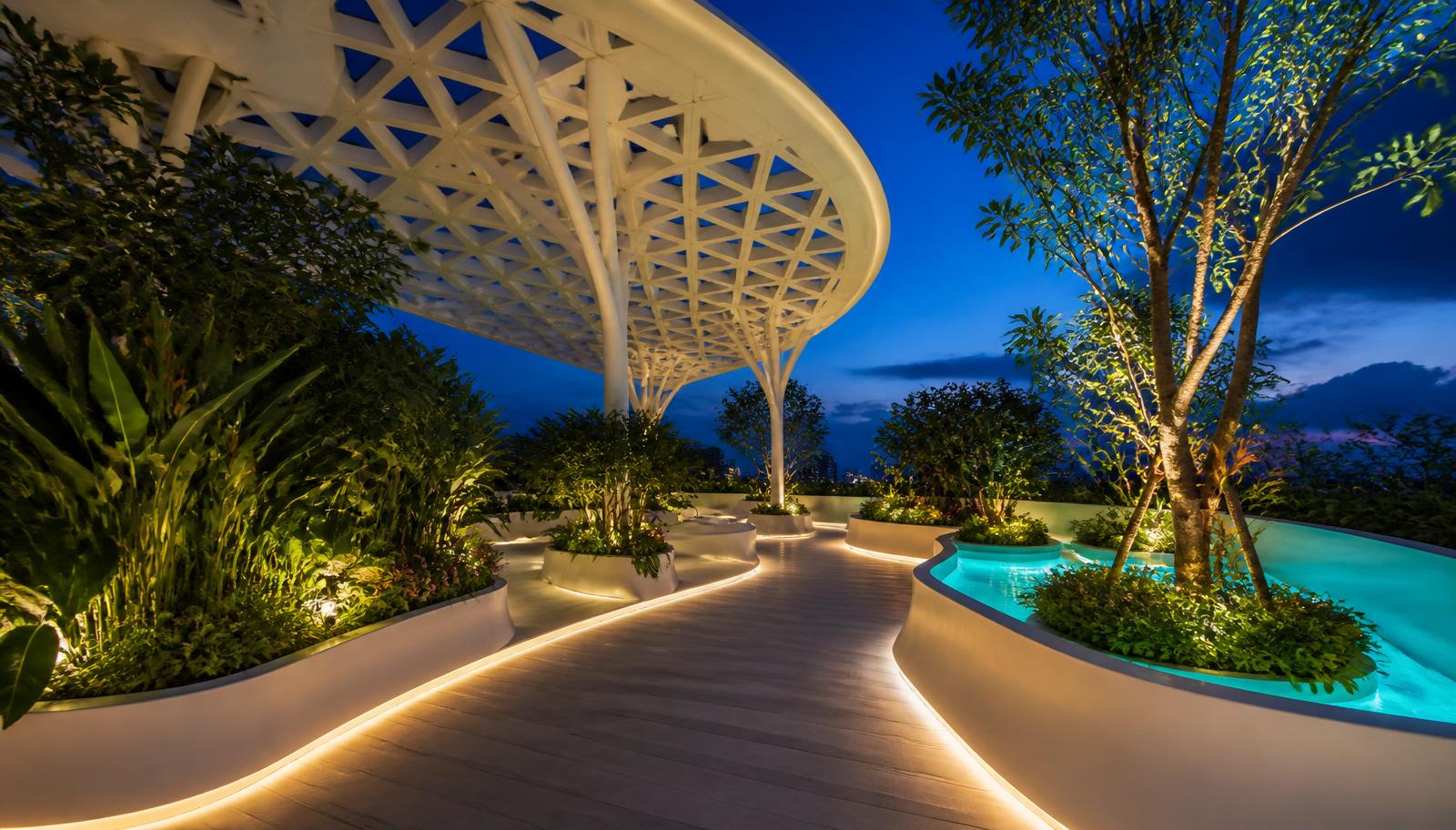
This is where garden design is heading, and it is impossible to ignore. A single sculptural ribbon of white lattice twists out over the water, floating stone islands carry their own sculptural trees, and cascades spill down the limestone terraces behind. Nothing here was added at the end of a build — the garden and the structure were drawn as one object, and that is the biggest shift of the next decade.
Getting this right at construction stage means running conduit for both irrigation and low-voltage lighting before the paving goes down, since retrofitting either through finished stonework is disruptive and expensive.
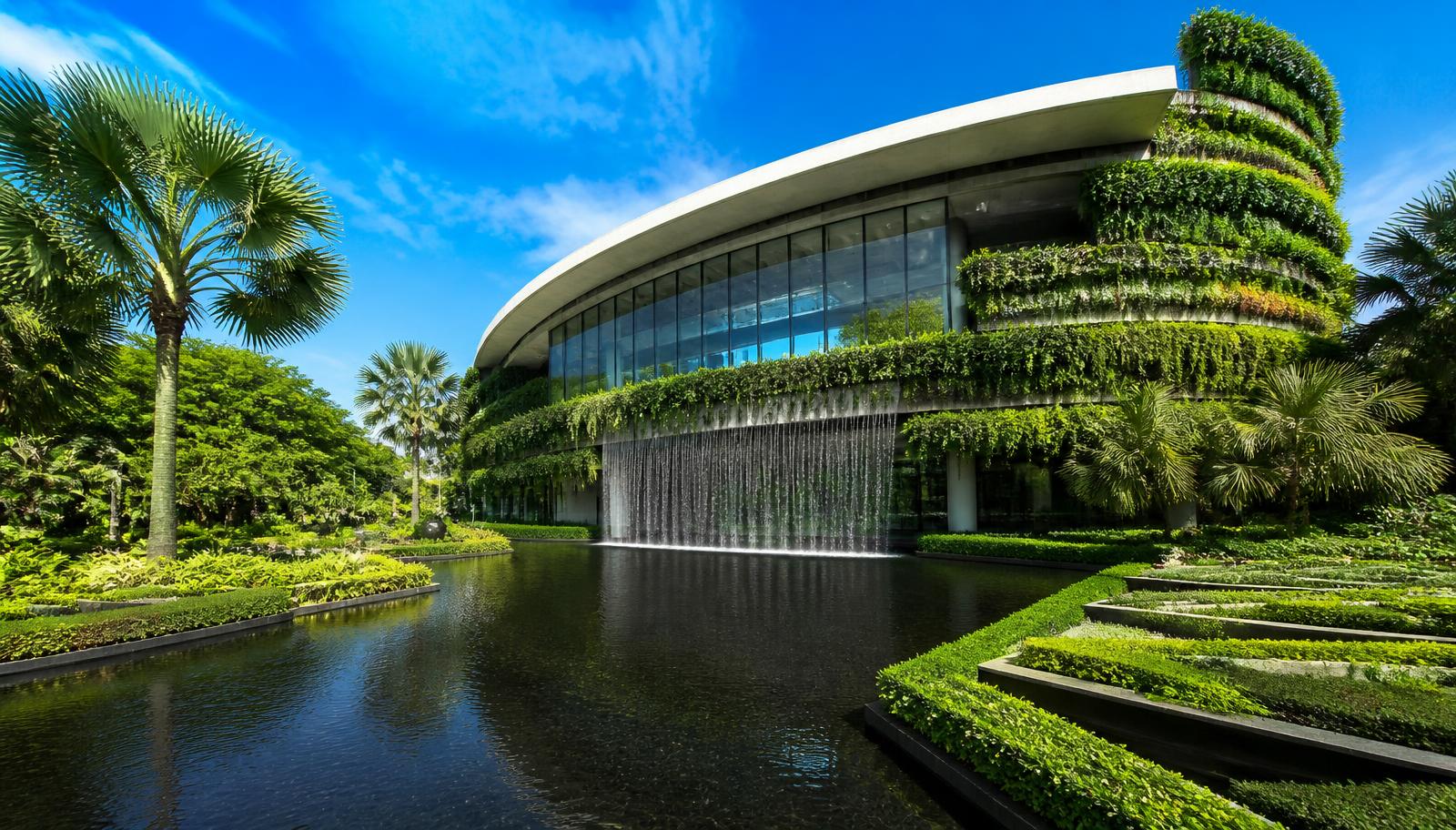
Four storeys of living wall, a sheet waterfall the full width of the building, and a black bottomed mirror pool that doubles every leaf above it. This is the future garden at full volume: plants used as facade, water used as floor, and geometry holding the whole thing together so the abundance never looks accidental.
Gardens that climb upward
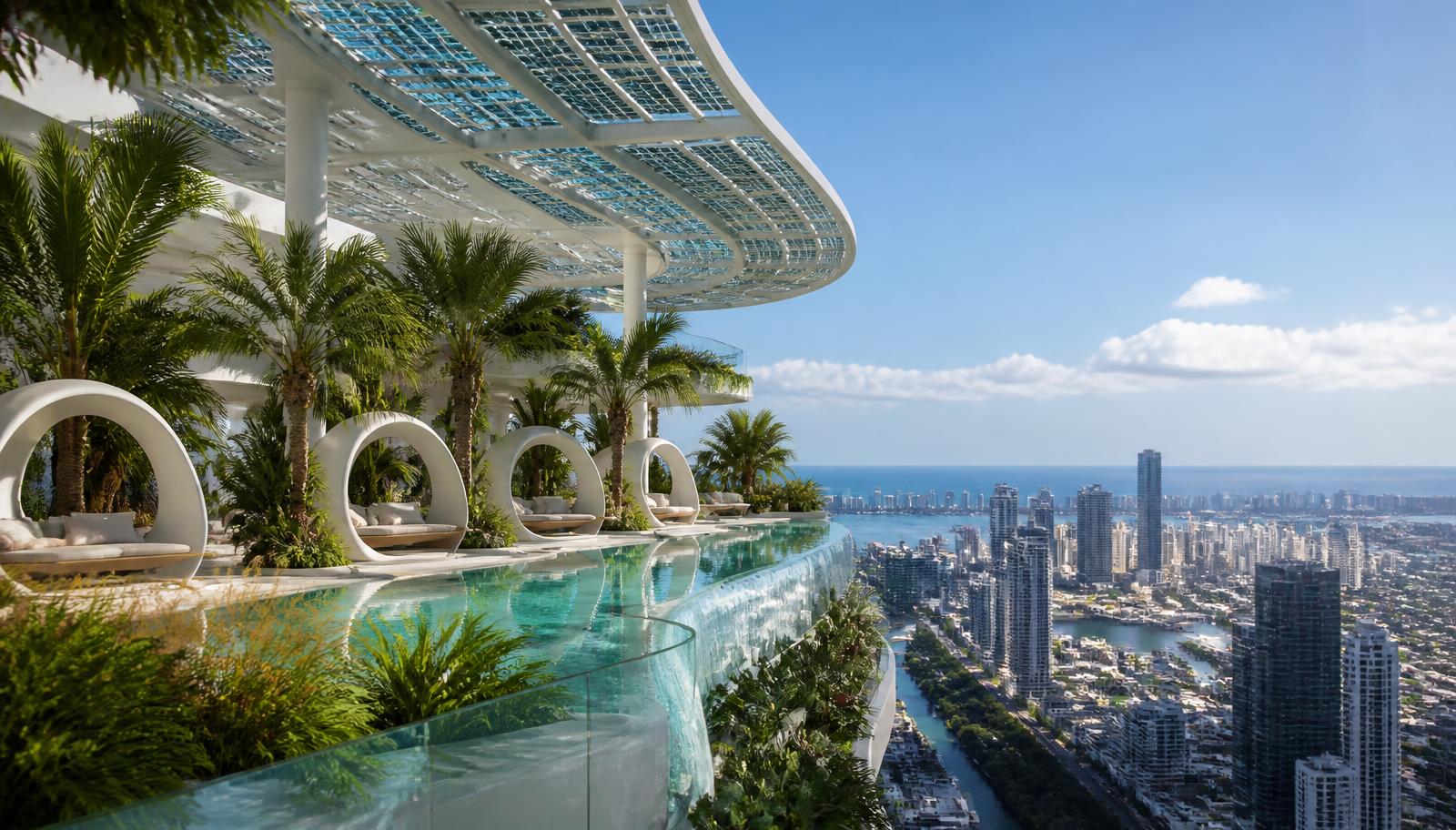
As land shrinks, the only direction left is up. A glass walled pool hangs over the skyline, white pod loungers sit under a curved solar canopy that powers the terrace, and a run of palms turns a rooftop slab into a jungle three hundred feet in the air. Nothing on the ground can compete with this view.
A black-tanked pool interior and a knife-edge overflow are what make the water disappear into the horizon rather than reading as a conventional swimming pool with visible tiled walls.
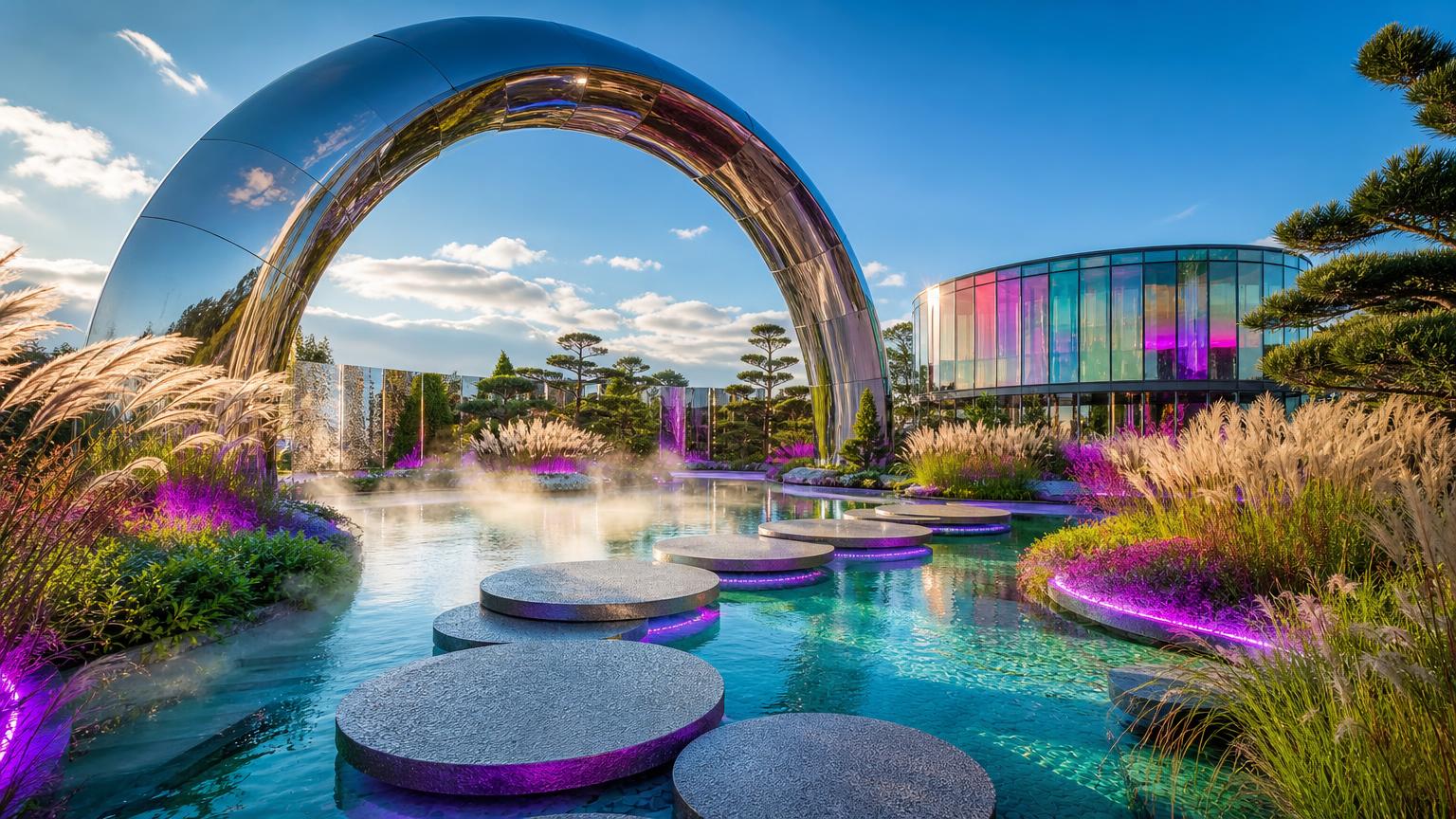
One monumental object, one path, one lagoon of mist — and now a wash of neon colour woven through the planting. Polished chrome picks up the sky, the stepping discs glow violet at their edges, and the prismatic pavilion shifts colour as you move. Dazzling does not mean loud; it means every surface catches light differently.
Then the sun goes down
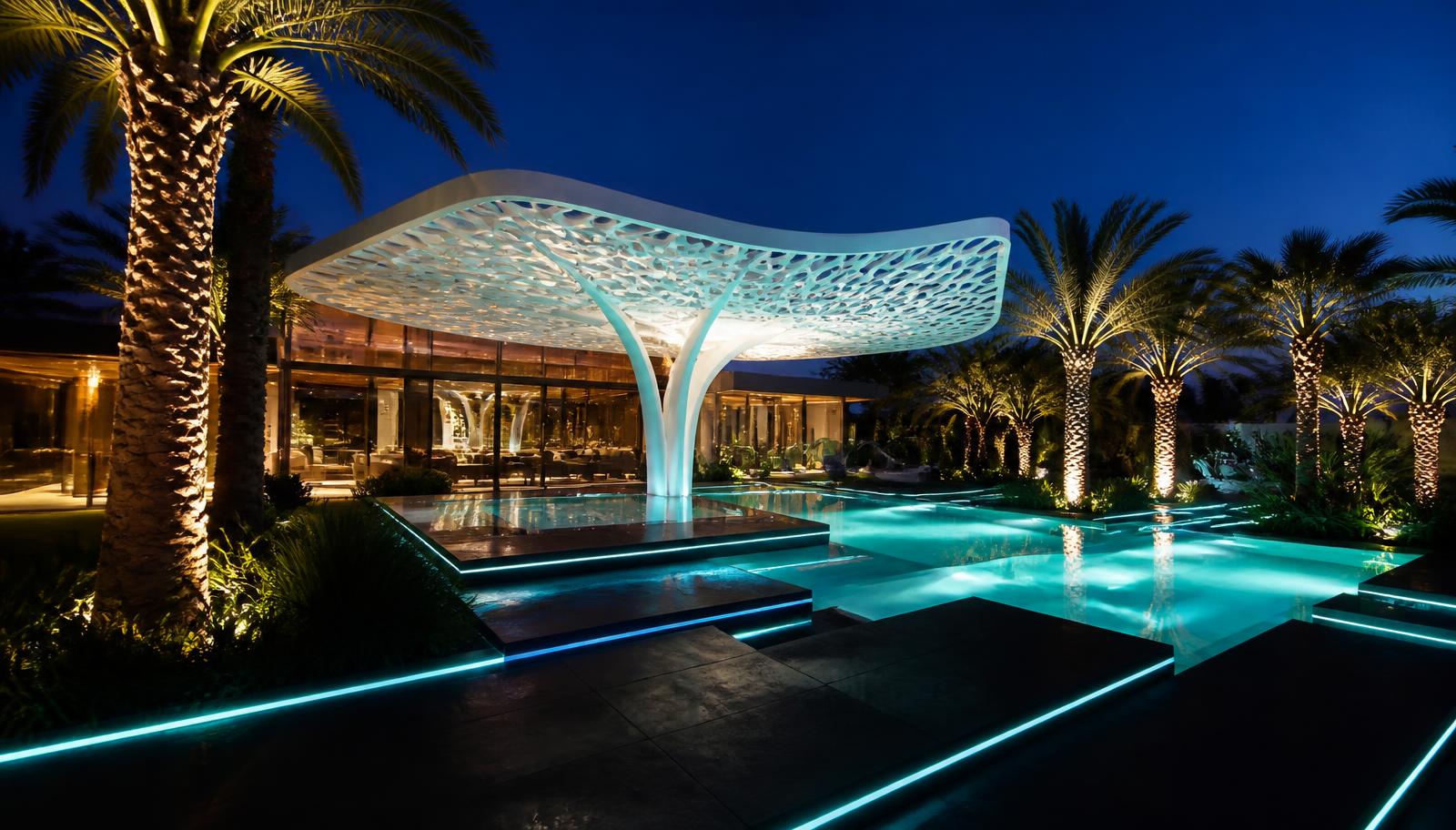
This is the same design language after dark, and it is effectively a different property. Cyan lines run through the black paving, the perforated canopy glows from within, the pool becomes a lantern and the palms are lit from the base up. Design your garden twice — once for sunlight, once for the switch.
Solar panels integrated into the canopy structure itself, rather than bolted on afterwards, can offset a meaningful share of the pool pump and lighting load across a sunny climate.

Programmable colour is the boldest tool in the night garden. Magenta and violet grow lighting turns a living wall into theatre while genuinely feeding the plants by day, and one cyan-lit waterfall supplies the sound, the movement and the only cool light in the scene.
Lit water and open flame
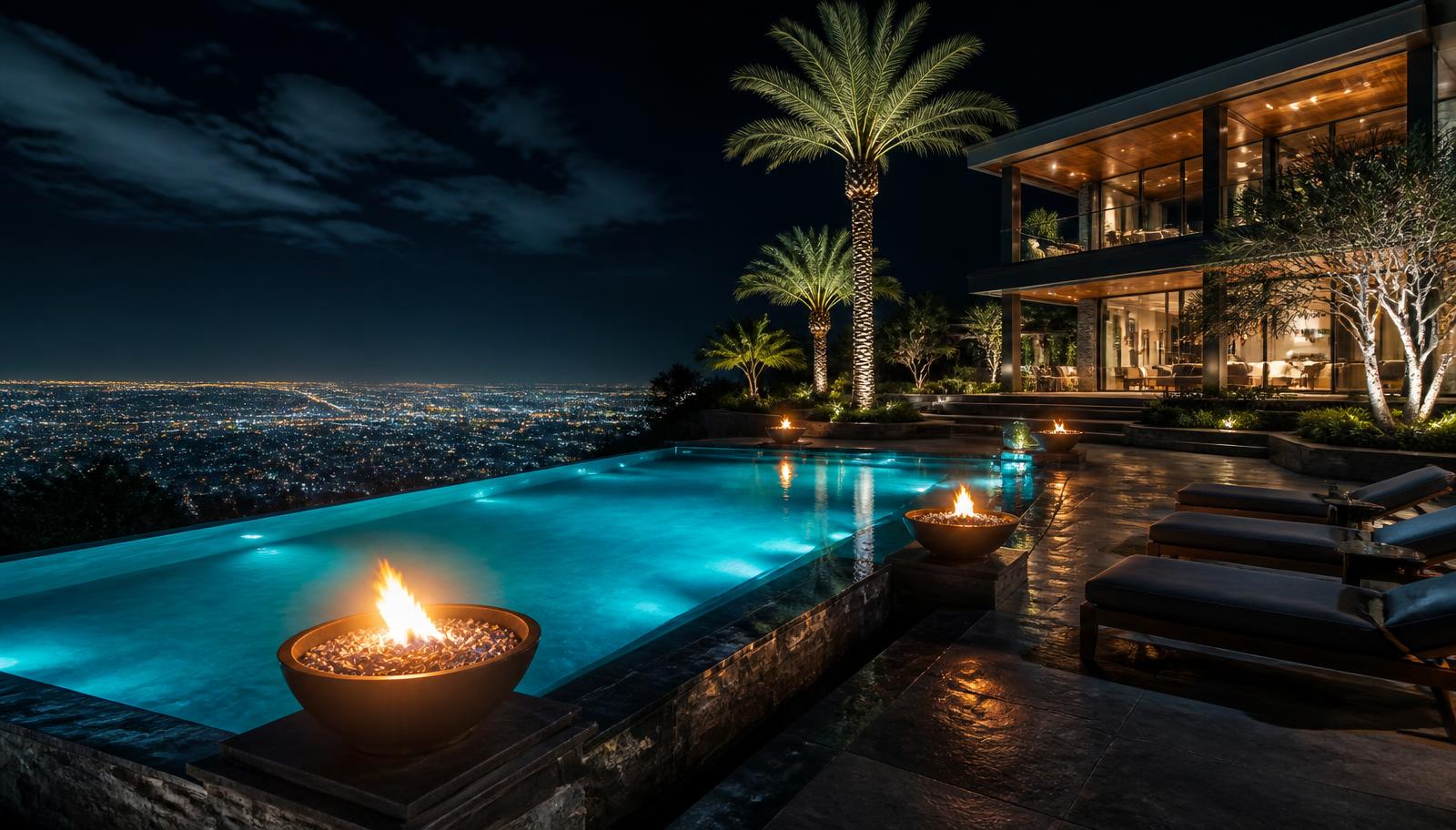
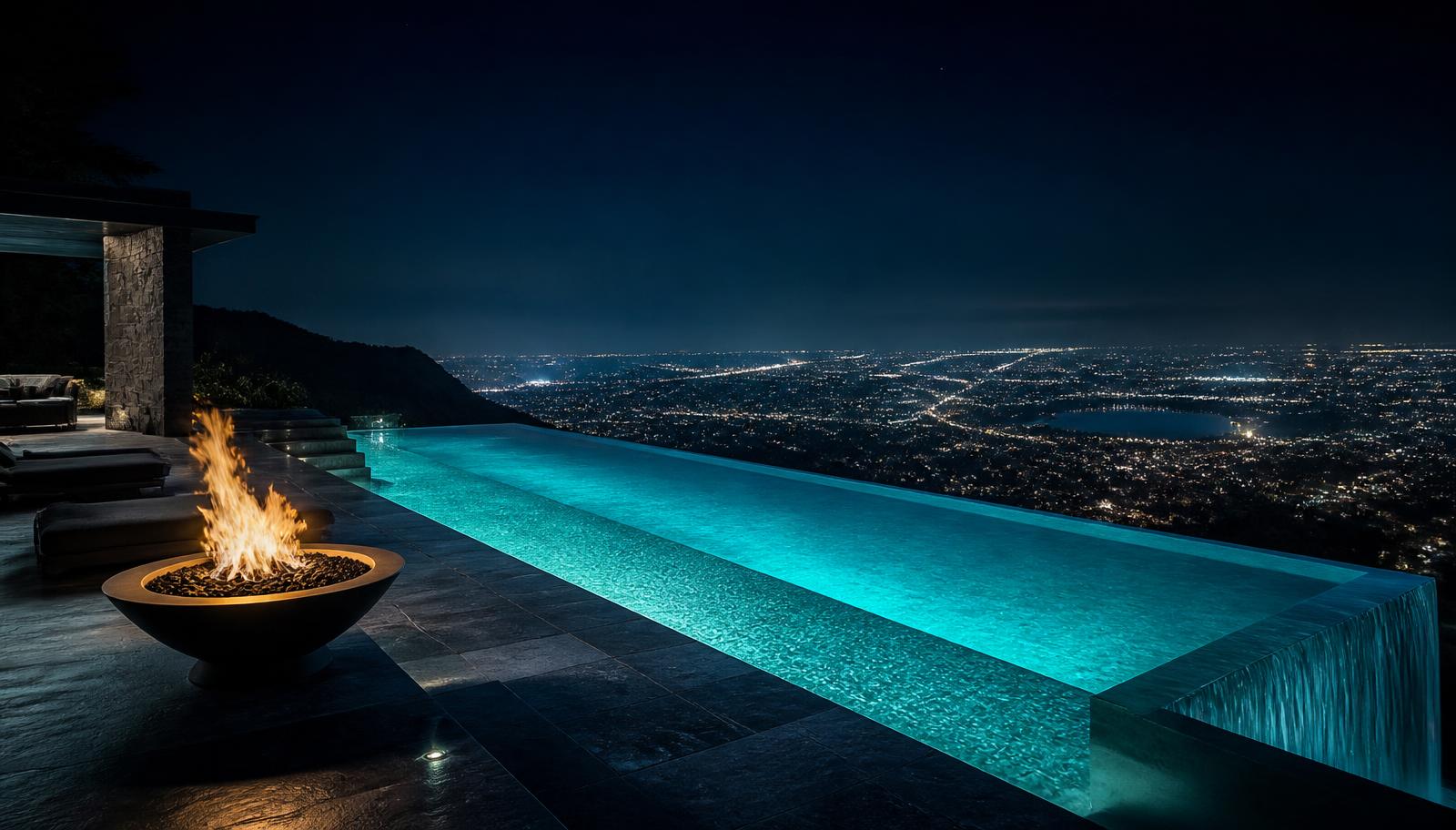
These are the two strongest night-time materials in any garden. Underwater light turns the pool into the brightest object on the property, fire bowls give the eye somewhere warm to land, and the city below does the rest. Everything else stays deliberately black.
Programming the whole scene from a single smart home app, rather than a wall of individual switches, is what actually makes daily use of a garden like this realistic.
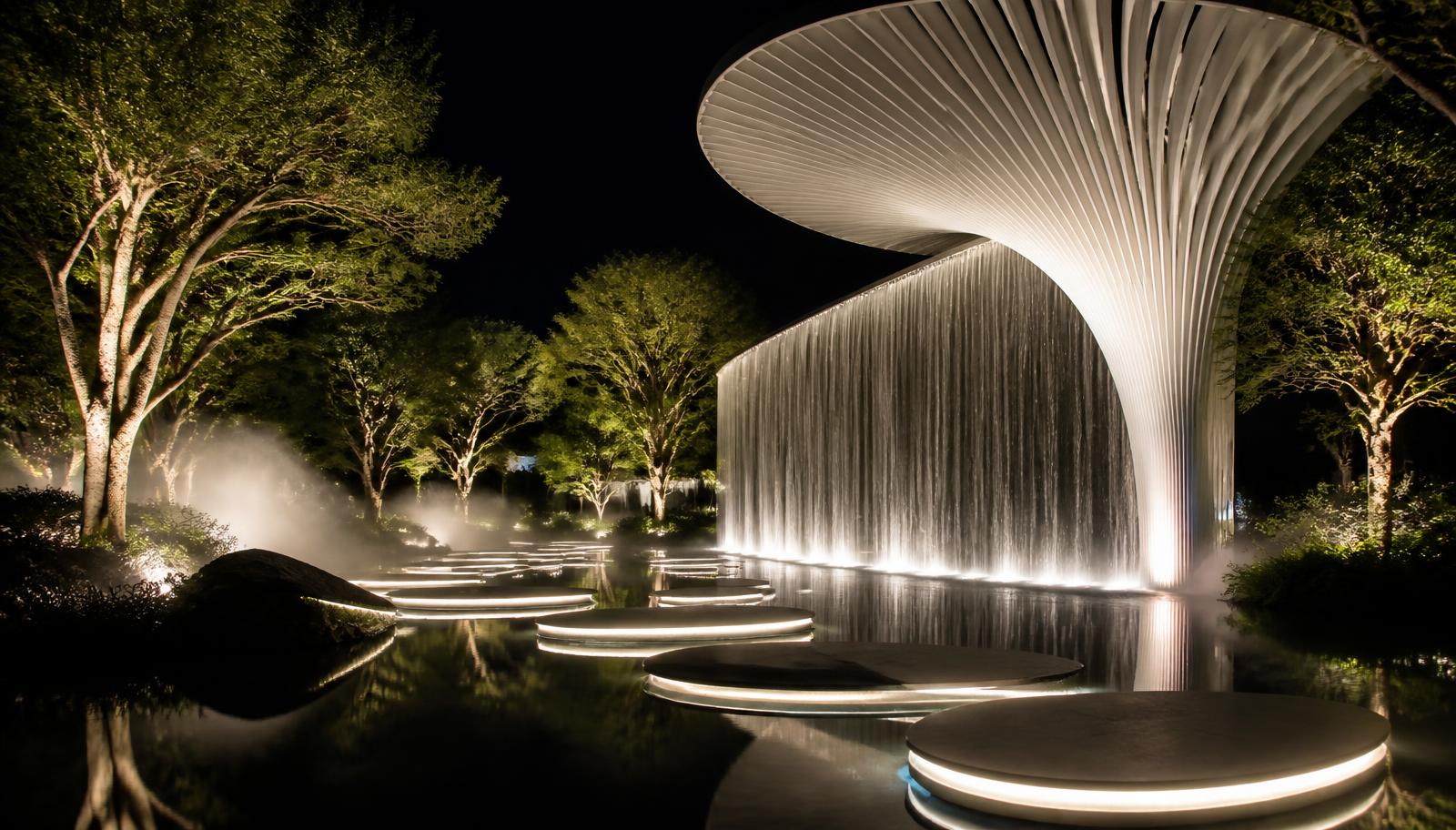
Light the treads, not the garden. Concealed strips under each floating disc make the path appear to hover, the ribbed canopy glows from inside its own structure, and a lit sheet of falling water closes the view. You never see a fitting — only what it touches.
Plan view first
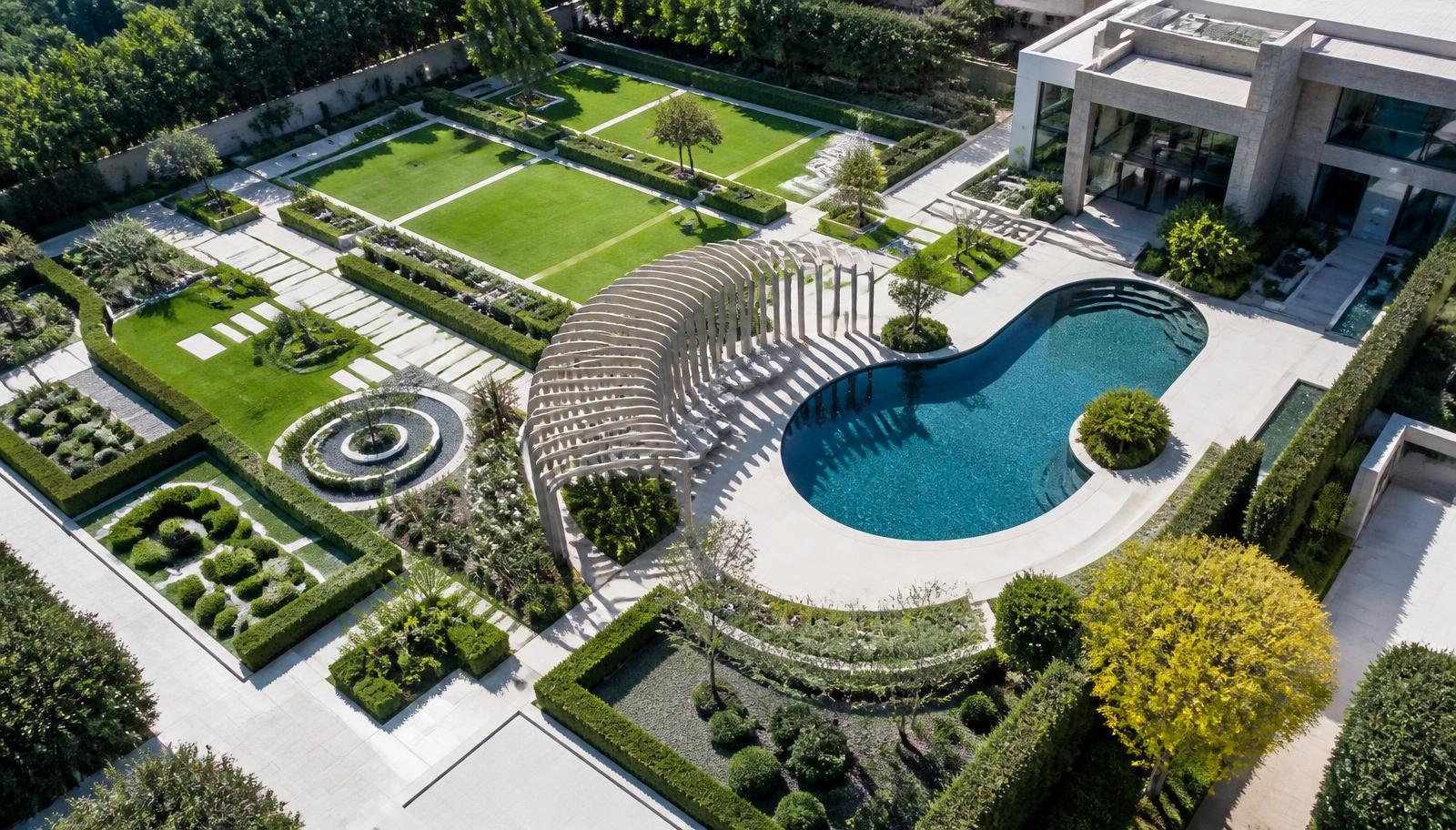
Geometric gardens live or die in the plan. Look at the property from above and resolve the big shapes — lawn panels, terrace grid, pool curve, hedge lines — before you think about plant names. Everything at eye level is a consequence of decisions made on that overhead drawing.
Drone-based site surveys are now routinely used at the design stage of gardens this scale, since they reveal drainage falls and existing service runs far faster than a ground survey alone.
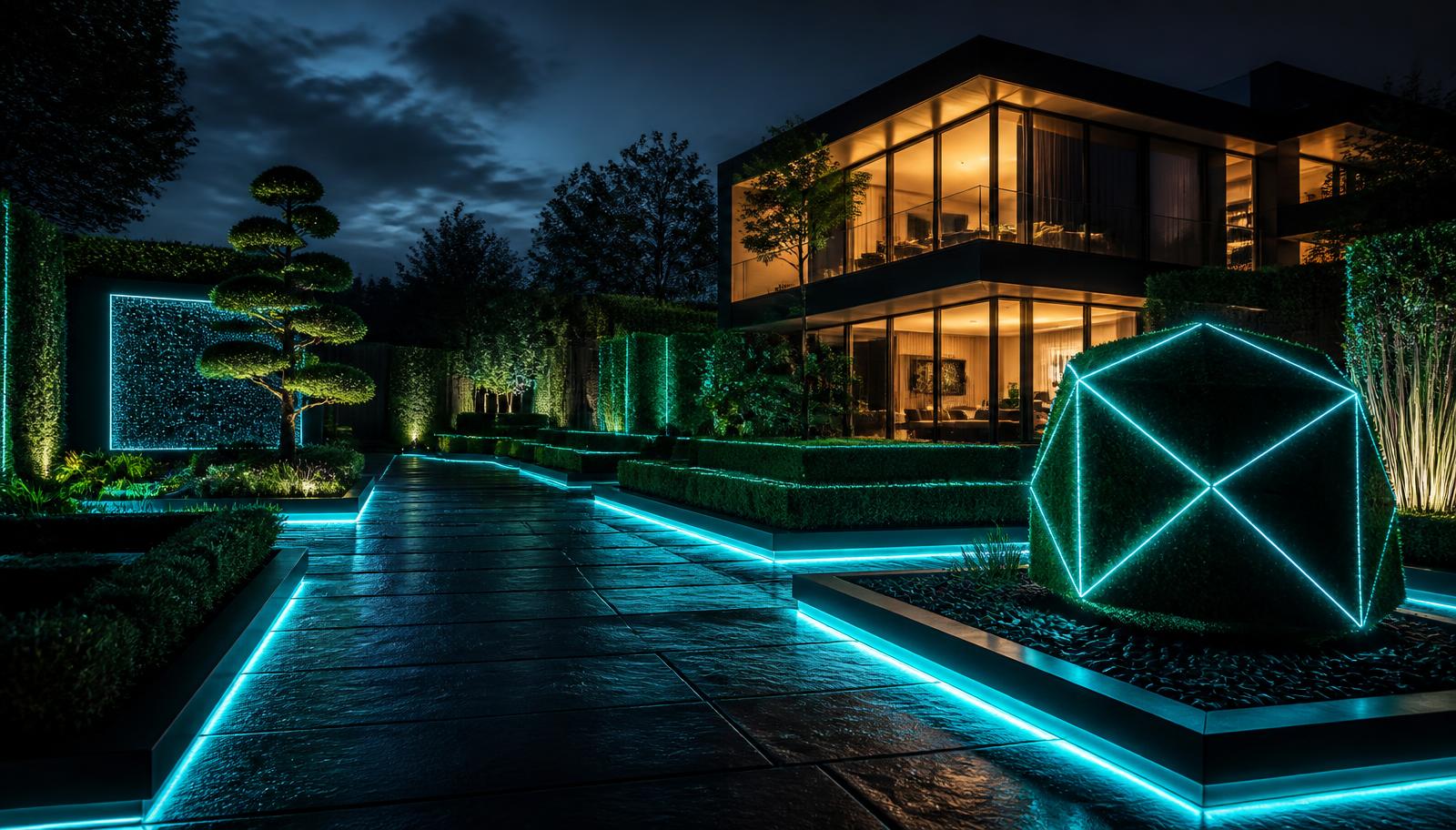
The garden switches on
This is the same kind of garden as the daylight images above, seen after dark, and it is effectively a different property. Cyan lines traced along paving edges, one lit geometric hedge as the hero, and the house glowing warm behind it. Design your garden twice — once for sunlight and once for the switch.
A dedicated parcel drop hatch built into the boundary wall keeps deliveries away from the ornamental entry sequence, which matters on a property where every surface is designed to be photographed.
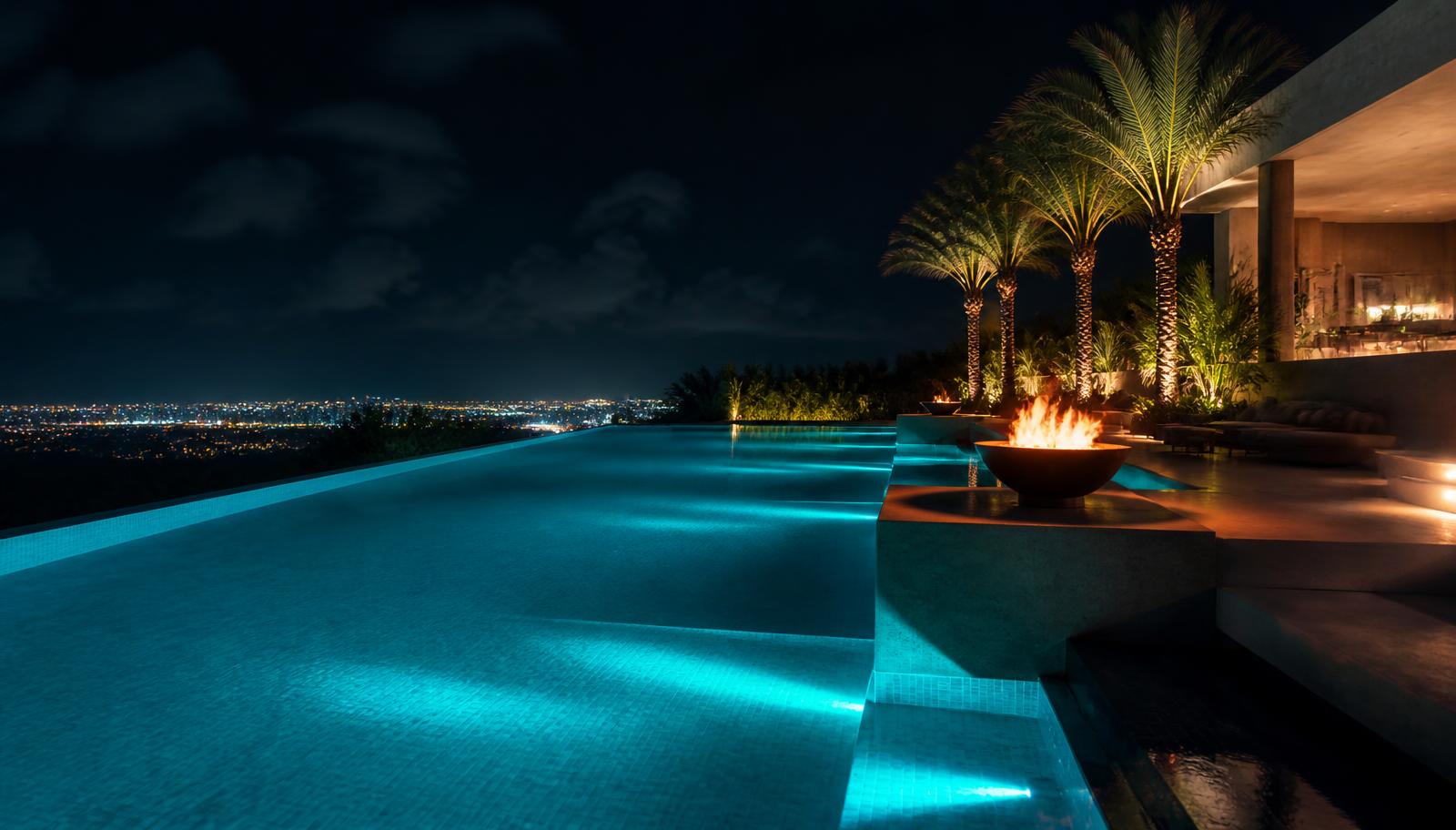
Lit water and open flame are the two strongest night-time tools in a garden. Turquoise underwater lighting turns the pool into a lantern, and one fire bowl on the axis gives the eye somewhere warm to land. Keep everything else dark and the contrast does the work.
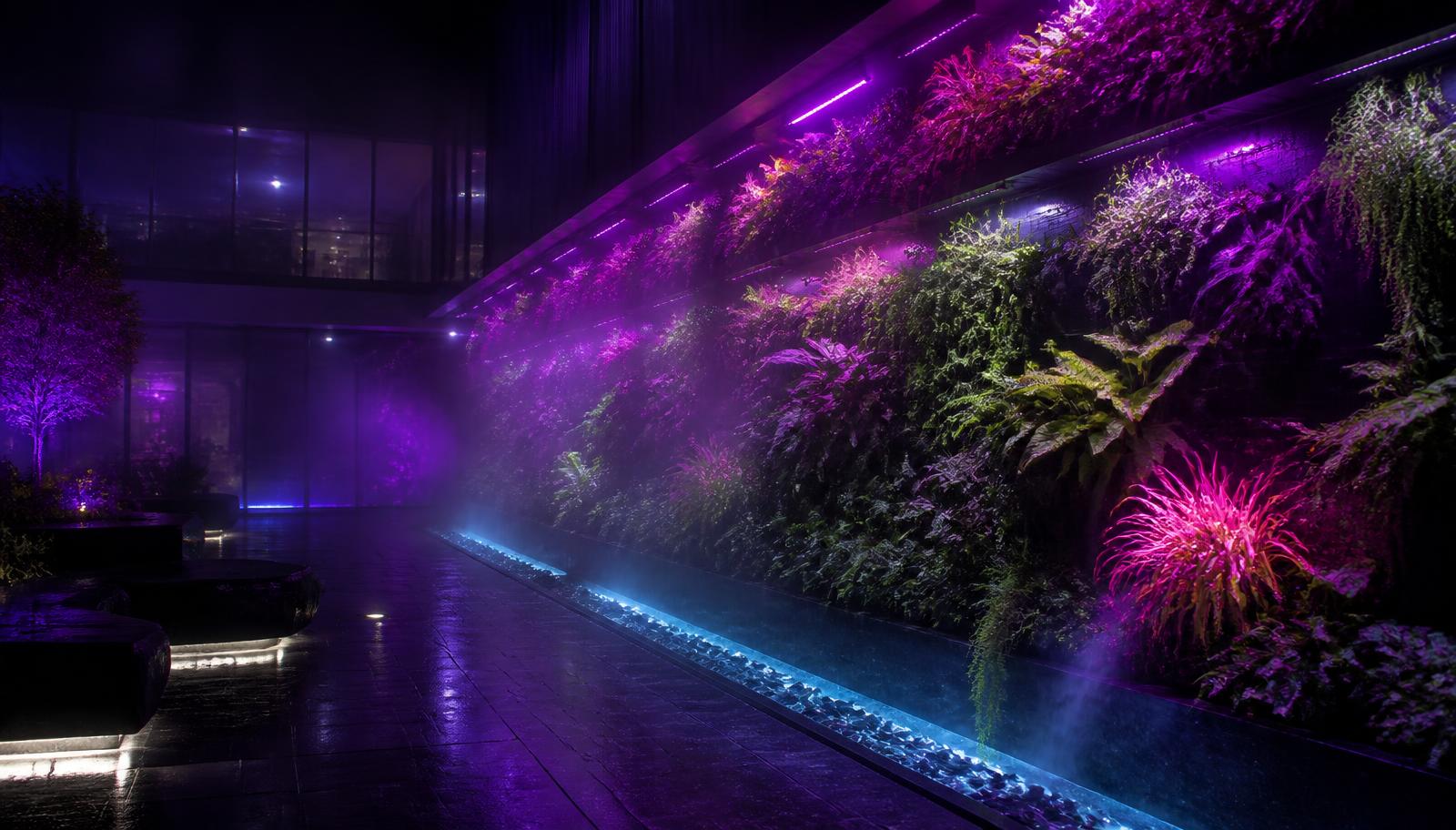
Colour as a night-time material
Programmable colour changes the mood of a courtyard in seconds. Magenta and violet grow lighting reads as theatrical after dark while genuinely helping the plants during the day, and a cyan strip washing a pebble channel finishes the composition at floor level.
Battery storage paired with rooftop or canopy solar lets the lighting and pump loads run through the evening peak without drawing from the grid at the moment electricity costs the most.
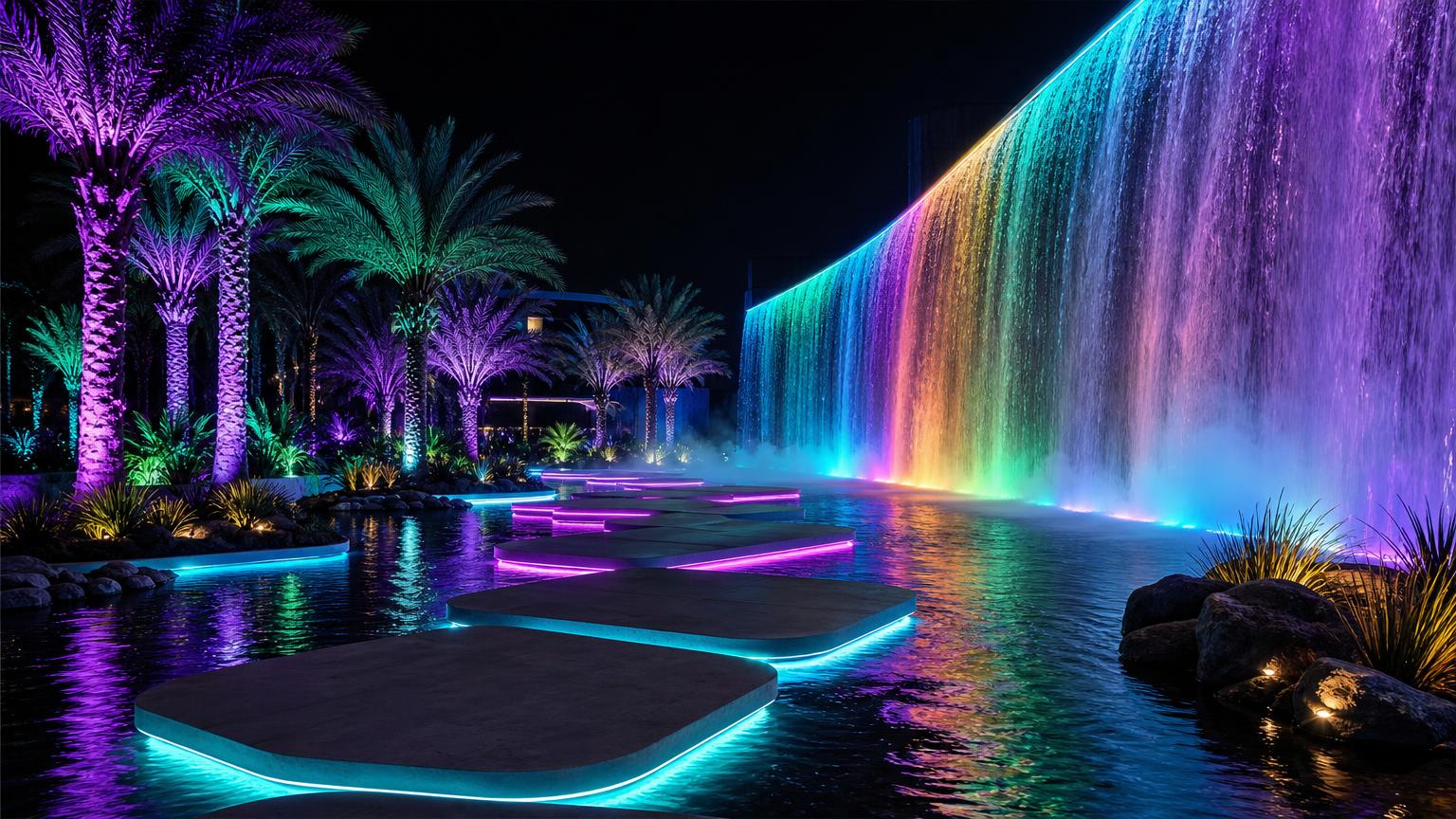
Light the treads, and then make the water a canvas. Neon strips under each floating platform turn the path into a glowing chain, while a waterfall wall washed in shifting rainbow LED becomes the whole garden's heartbeat. Colour is no longer decoration here — it is the structure of the night.
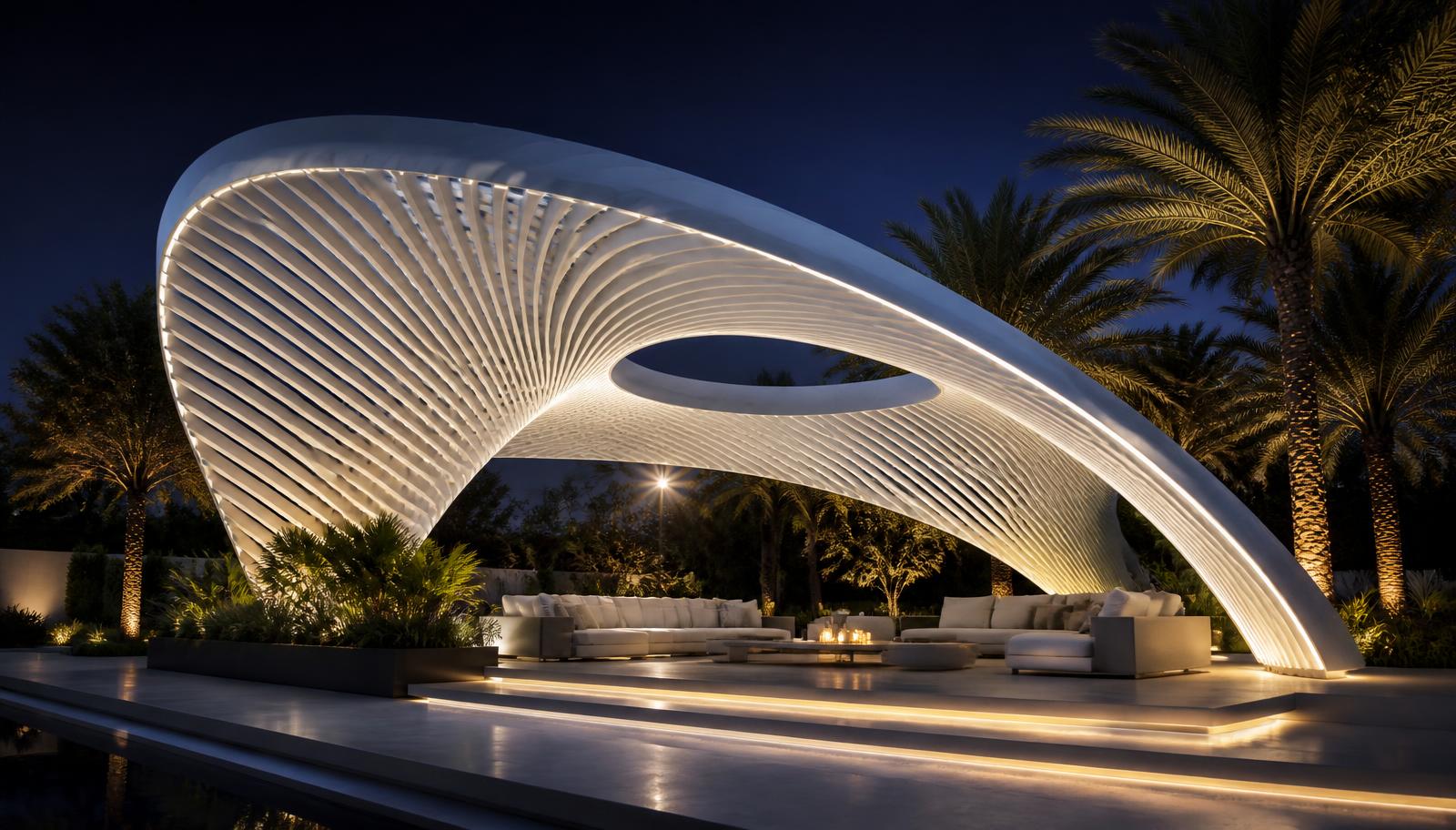
One object, endlessly photographed
Future gardens increasingly include a single sculptural structure that carries the whole identity of the property. Ribbed, CNC-cut and edge-lit, it is a shade canopy by day and a glowing sculpture by night — the element every visitor photographs.
Concealed low-voltage wiring routed through planter walls and paving joints keeps every fitting invisible by day, which is the only way this much lighting avoids looking cluttered.
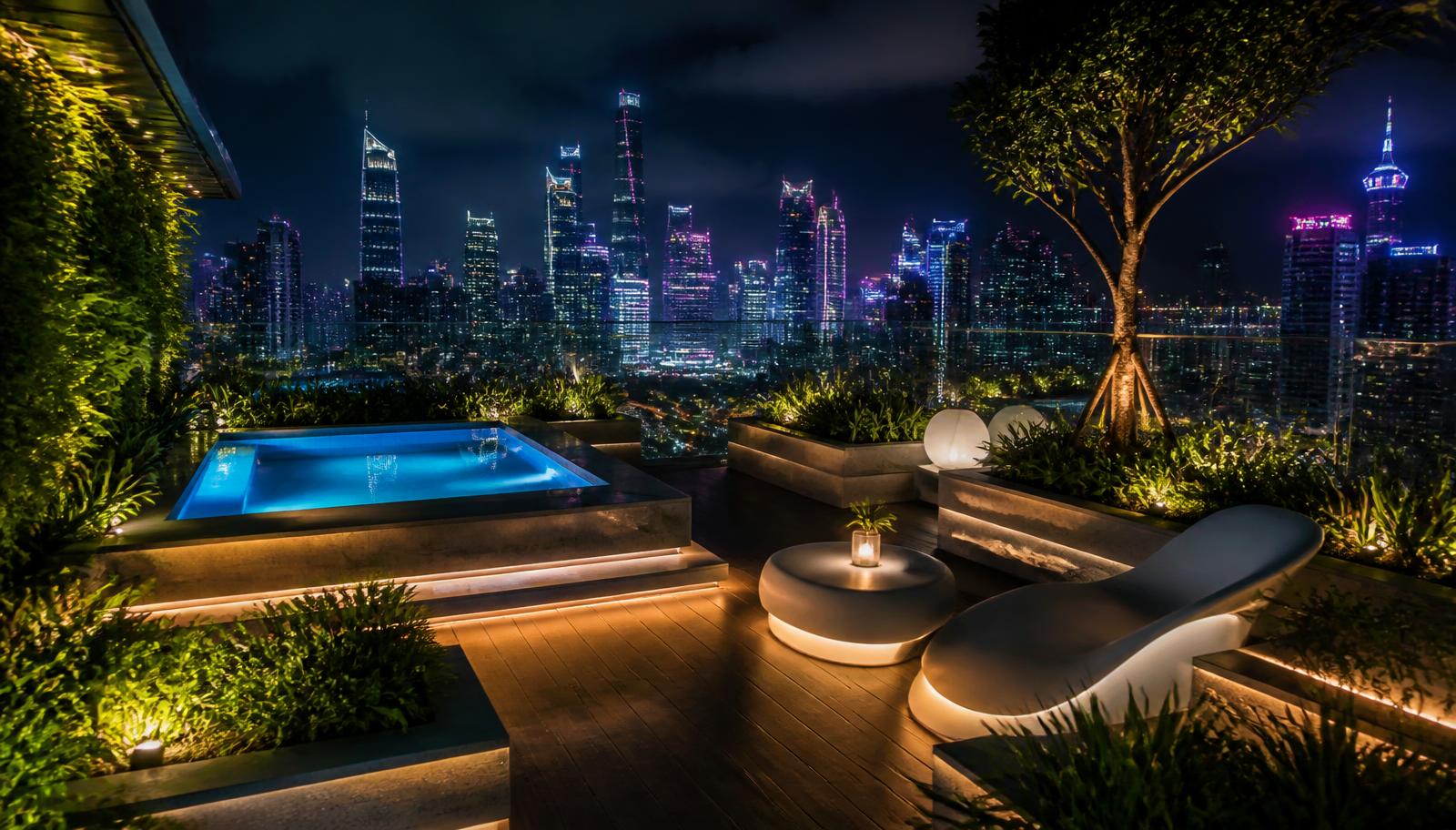
On a roof, the borrowed view is the garden's best planting. Keep the lighting low and warm so the skyline stays visible, wash light along planter edges instead of aiming it upward, and let the plunge pool supply the only cool colour on the terrace.
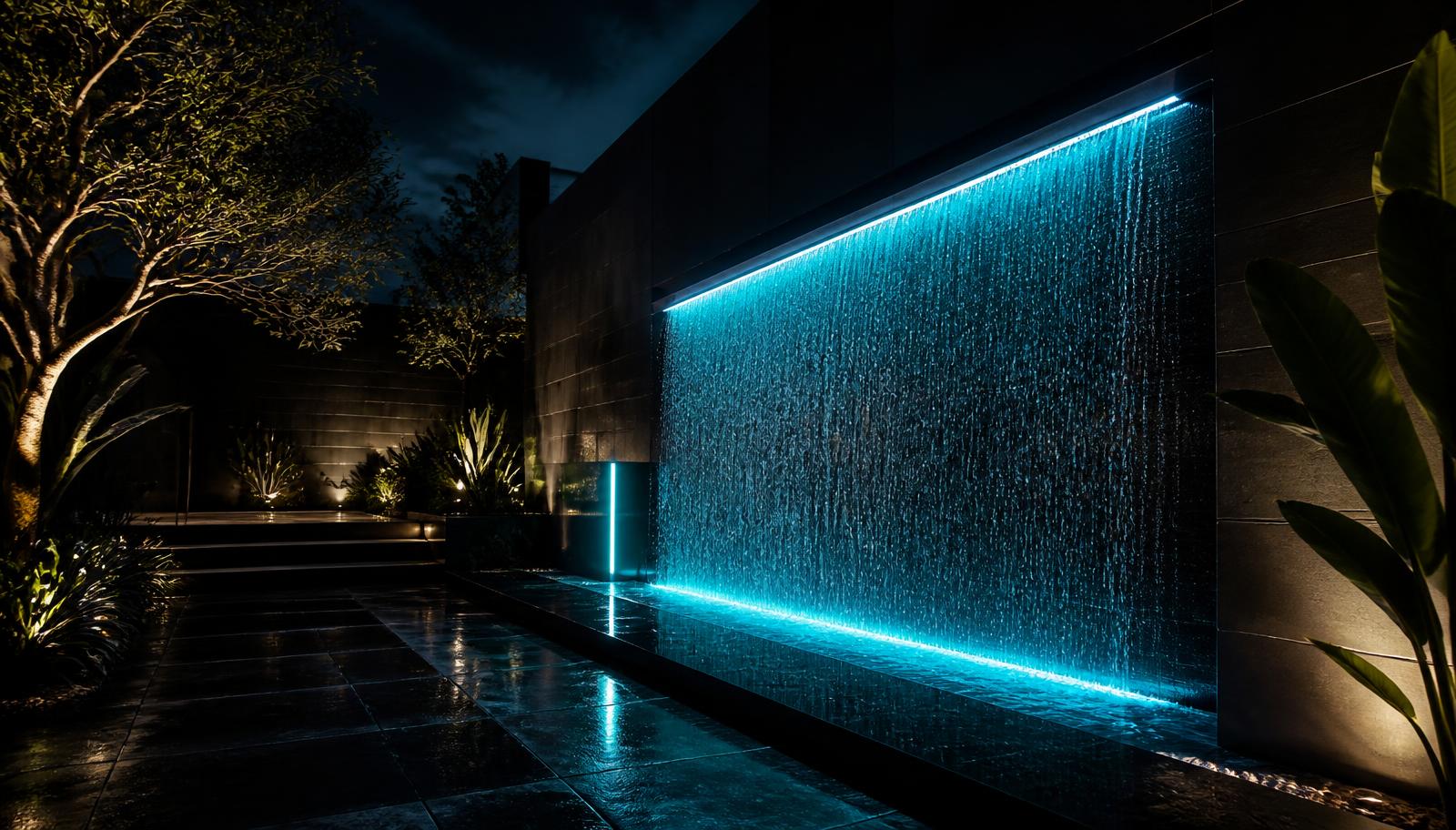
Radiating water walls
A slot-lit water wall is the most reliable wow feature in a small garden. The moving sheet catches light, throws sound over neighbourhood noise, and needs less than a square metre of floor. Light it from the top and the bottom only, never from the front.
Weather-linked controllers that check a live forecast before triggering irrigation or closing louvres are now standard on gardens of this ambition, removing the guesswork of manual scheduling.
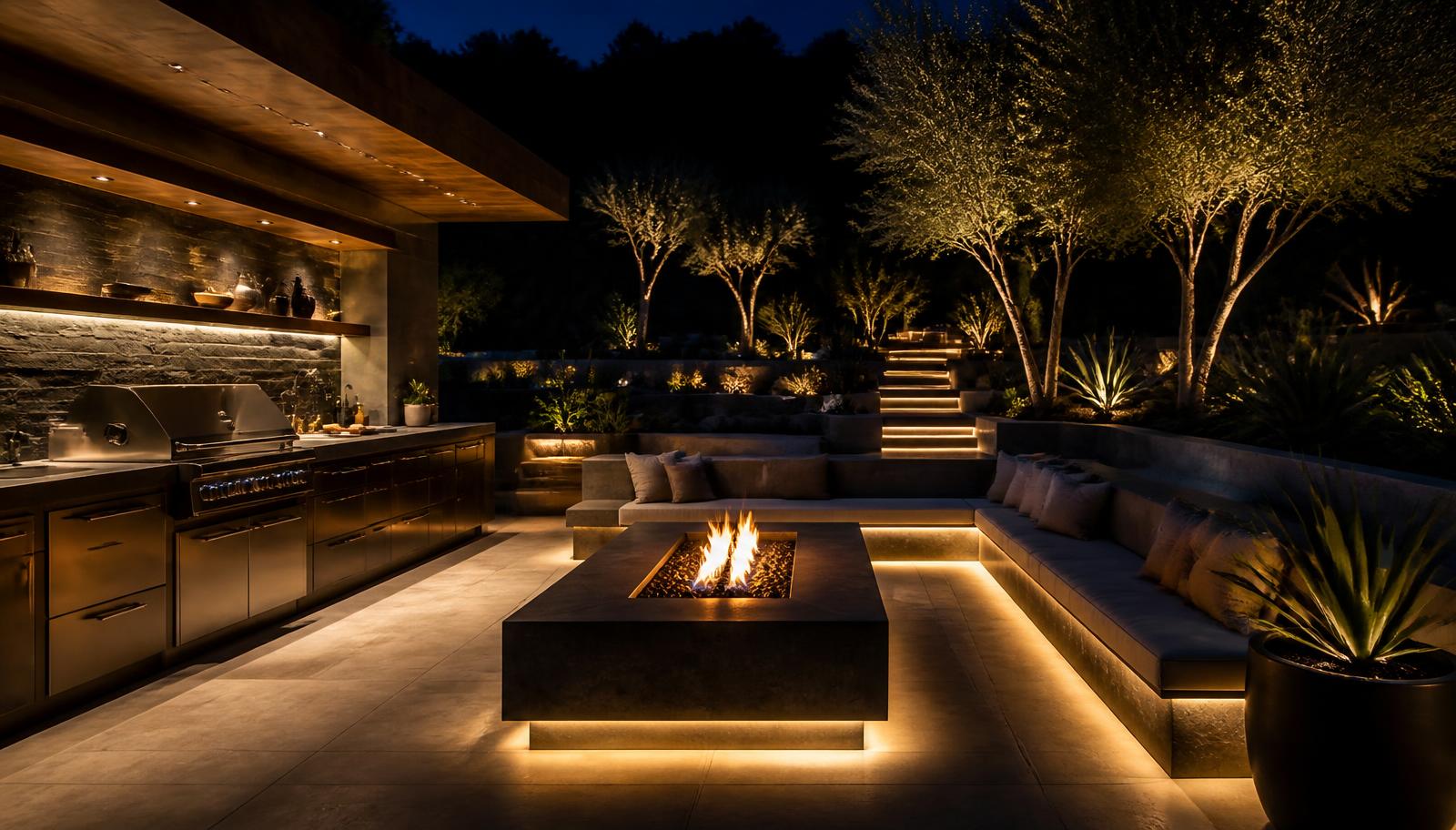
Strip lighting tucked beneath bench seats, steps and counters makes an entertaining terrace feel like a hotel without a single visible fitting. Add one long fire table and the space works in the middle of winter, which is where the real value of a future garden sits.
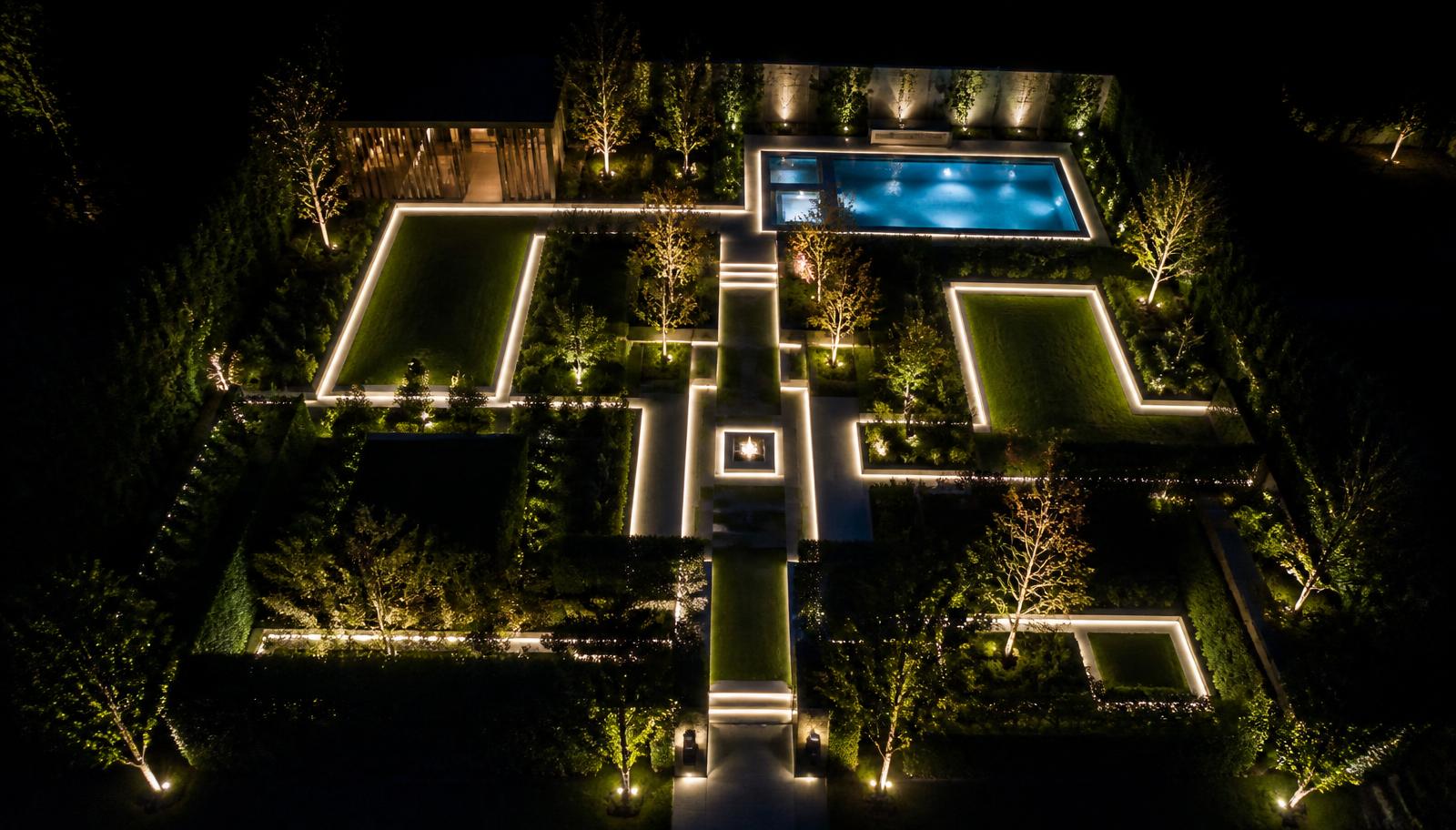
Night geometry from above
From a drone at night, a well lit garden becomes a drawing of itself. Outlining lawn panels and path edges is what produces this effect, and it is the clearest proof that the plan you resolved on paper was worth resolving properly.
Maintaining colour consistency across dozens of individually addressable LED fittings requires a proper DMX or equivalent lighting protocol rather than simple on-off smart plugs.

Resort lighting is generous with warm light on trunks and stingy everywhere else. Uplighting the palms builds a lit ceiling, the lagoon supplies the glow at ground level, and floating day beds edge-lit from below finish the scene without a single bright fitting in view.
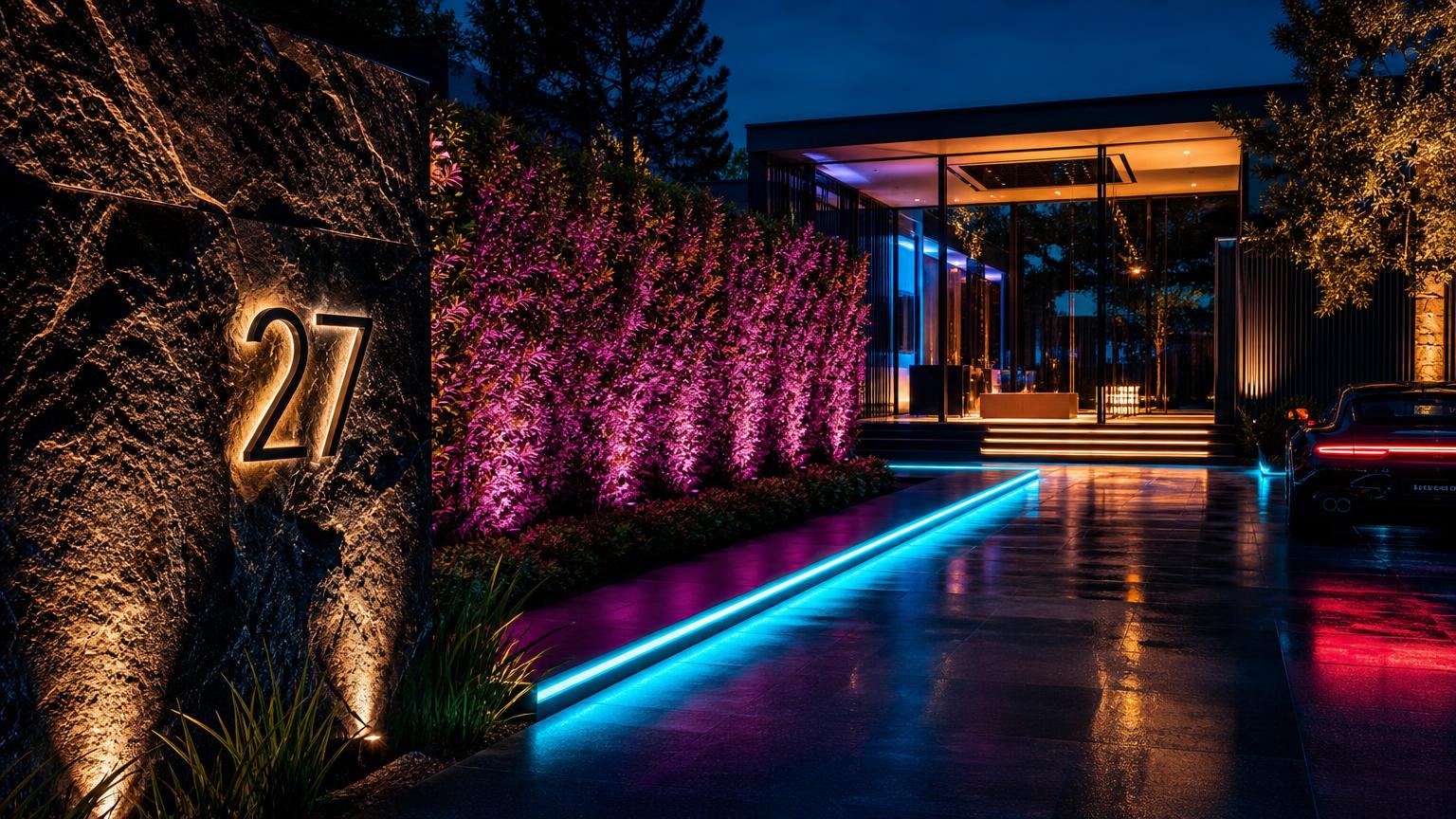
Arrival after dark
The front yard is where the future garden makes its first impression, and at night that impression is written in neon. Graze the texture of the entry wall, backlight the house number, run a cyan LED line along the driveway edge, and wash one sculptural hedge in magenta. The rest stays black, so the colour sings.
Getting this right at construction stage means running conduit for both irrigation and low-voltage lighting before the paving goes down, since retrofitting either through finished stonework is disruptive and expensive.
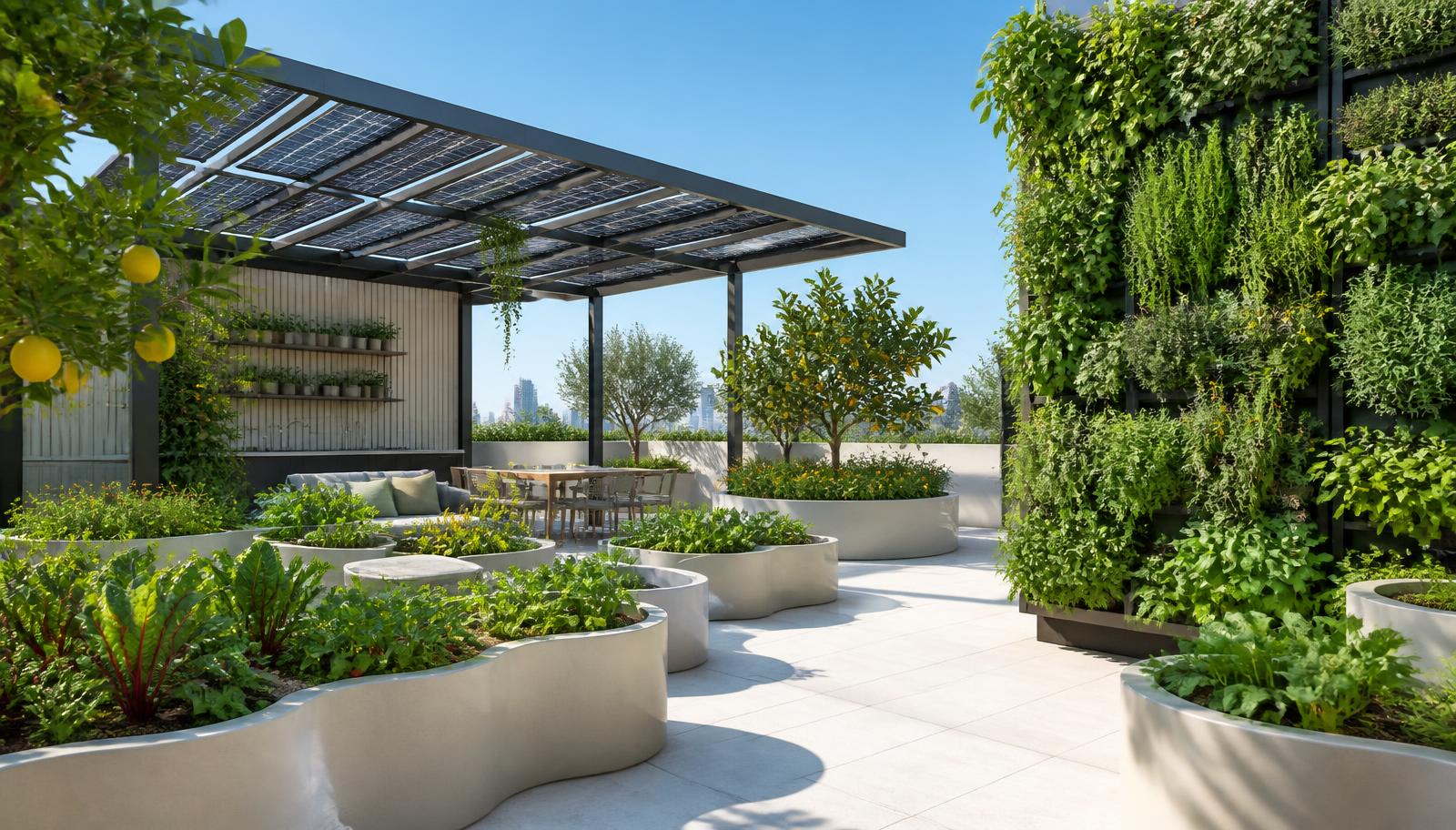
Beautiful and productive
Edible landscaping is shedding its scruffy reputation. Sculptural raised beds, a vertical herb wall and a solar pergola overhead deliver food, shade and power from the same footprint — and it still looks like a designed terrace rather than an allotment.
A black-tanked pool interior and a knife-edge overflow are what make the water disappear into the horizon rather than reading as a conventional swimming pool with visible tiled walls.
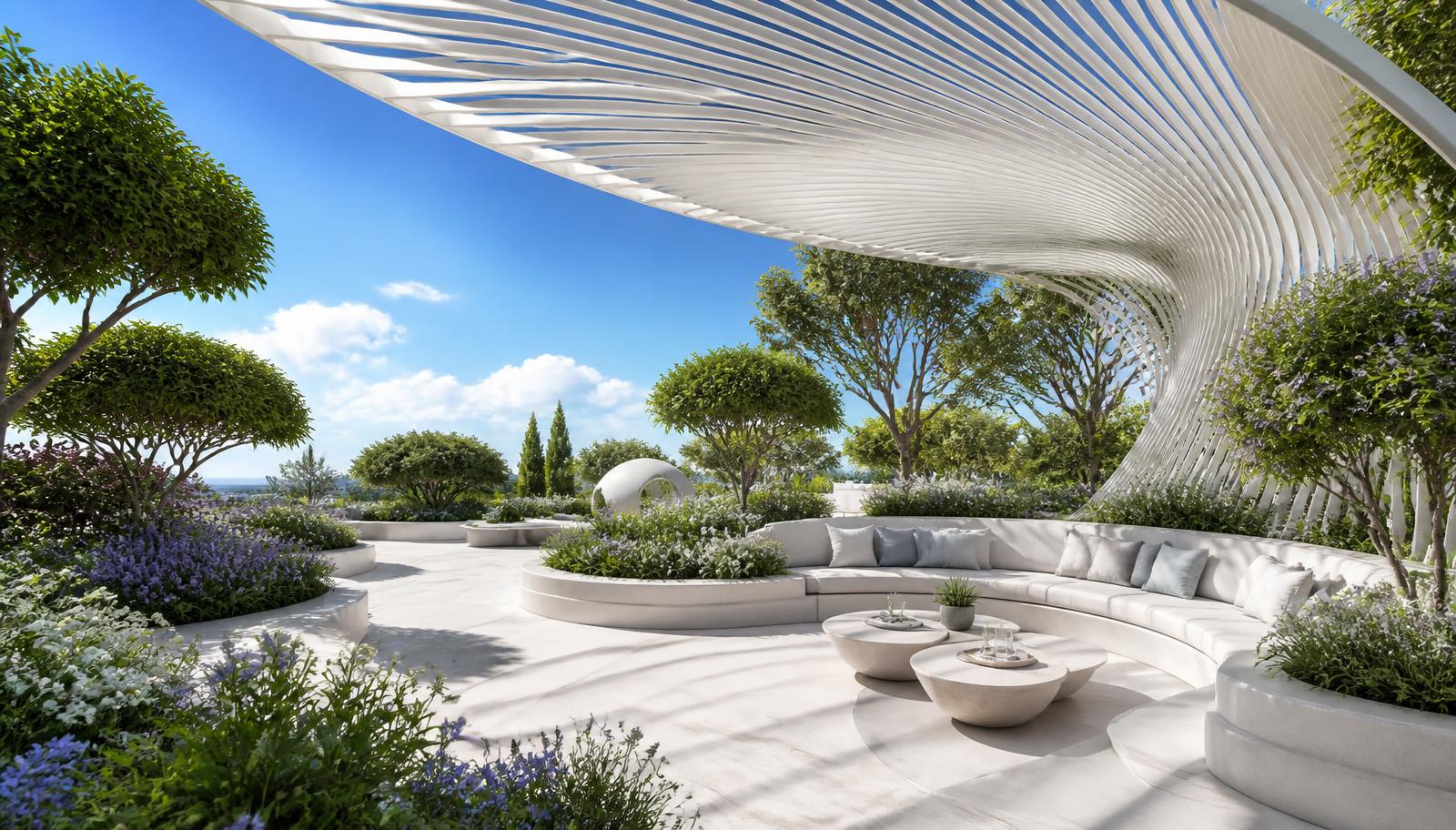
Fabrication technology is why these forms are arriving in ordinary gardens. Curved slat canopies and curved seating are now cut from a file, which means the shape costs little more than the straight version and delivers ten times the effect.
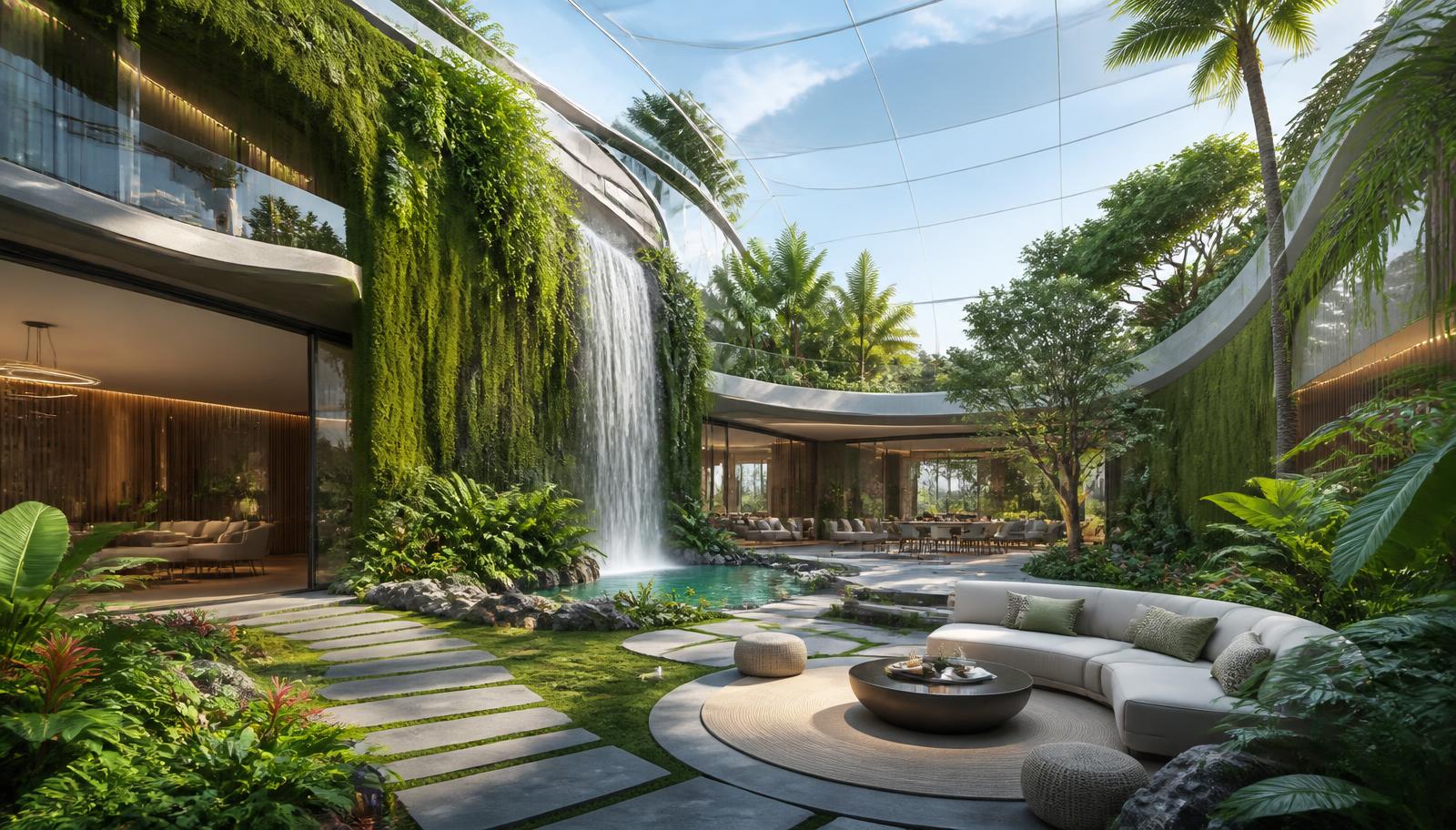
The boundary disappears
The most transformative future garden idea is the one that removes the wall entirely. A climate-tempered courtyard with a moss wall, a waterfall and full-height glass makes the garden a room you live in year round, in any weather.
Solar panels integrated into the canopy structure itself, rather than bolted on afterwards, can offset a meaningful share of the pool pump and lighting load across a sunny climate.
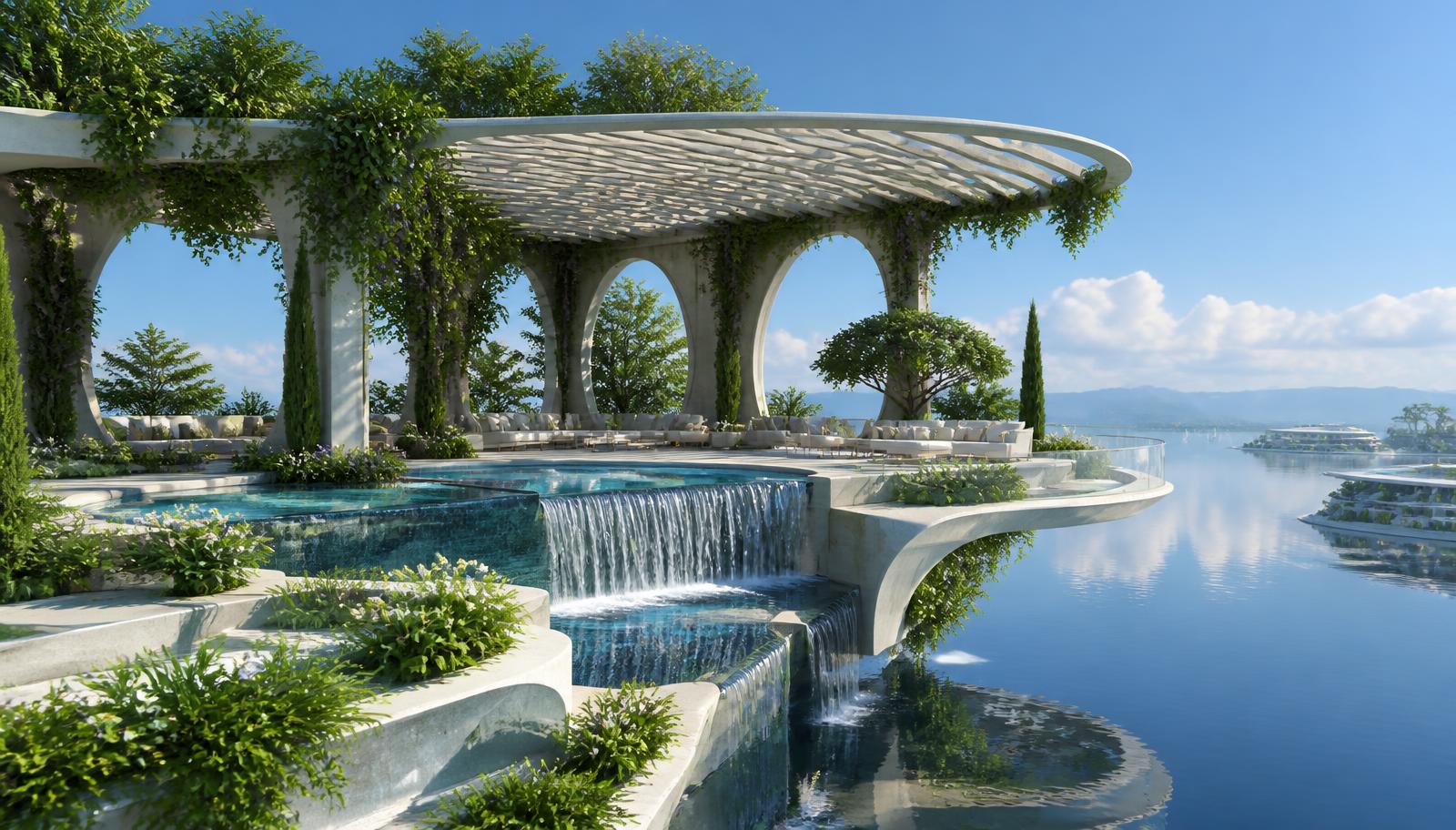
Water-integrated architecture is where garden design becomes sculpture. Terraces cascade, pools spill into pools, and the still water below returns the whole structure as a perfect reflection. Nothing produces a greater sense of arrival for less planting.
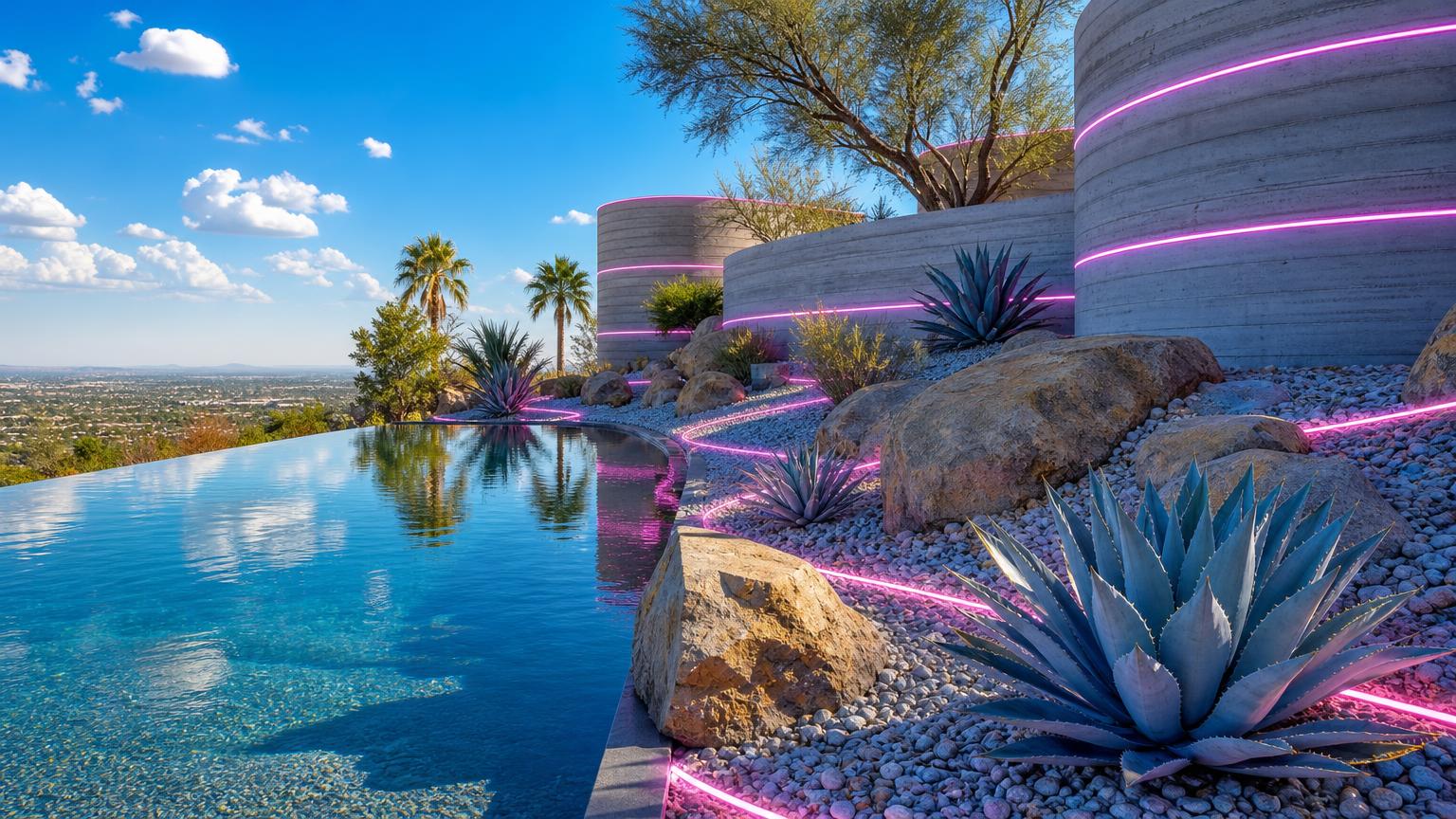
Water-wise, not water-free
Restraint is a future skill, but restraint can still dazzle. Gravel, boulders, sculptural agaves and curved concrete give a garden all the structure it needs on almost no irrigation, while magenta LED strips trace the wall edges so the shadows moving across those surfaces become a performance after sunset.
Programming the whole scene from a single smart home app, rather than a wall of individual switches, is what actually makes daily use of a garden like this realistic.
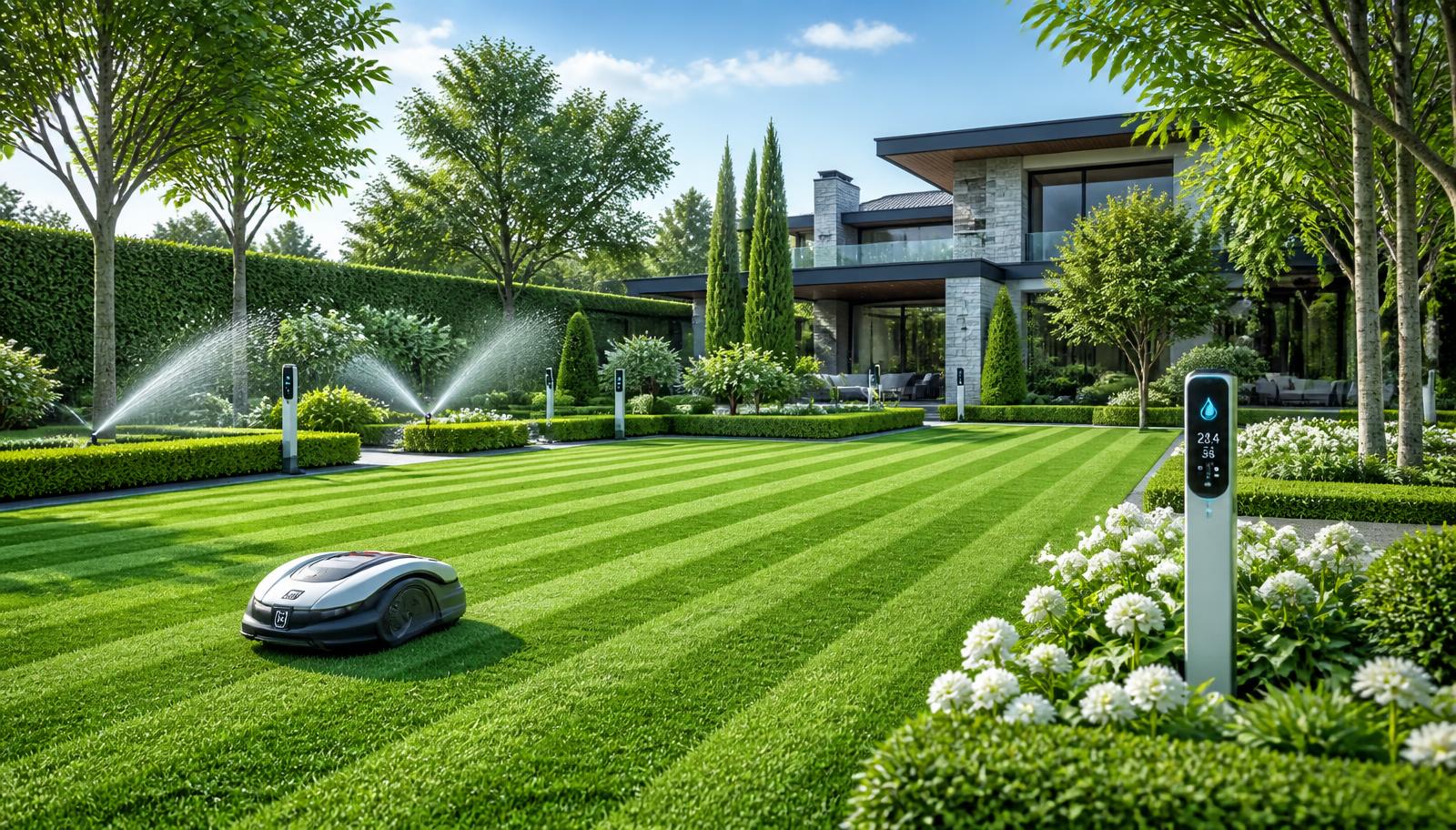
The garden that maintains itself
Robotic mowers, soil moisture sensors and weather-linked irrigation controllers are the least glamorous and most useful part of the future garden. They keep the lawn perfect, cut water use significantly, and remove the weekend chore that makes people give up on planting altogether.
Drone-based site surveys are now routinely used at the design stage of gardens this scale, since they reveal drainage falls and existing service runs far faster than a ground survey alone.
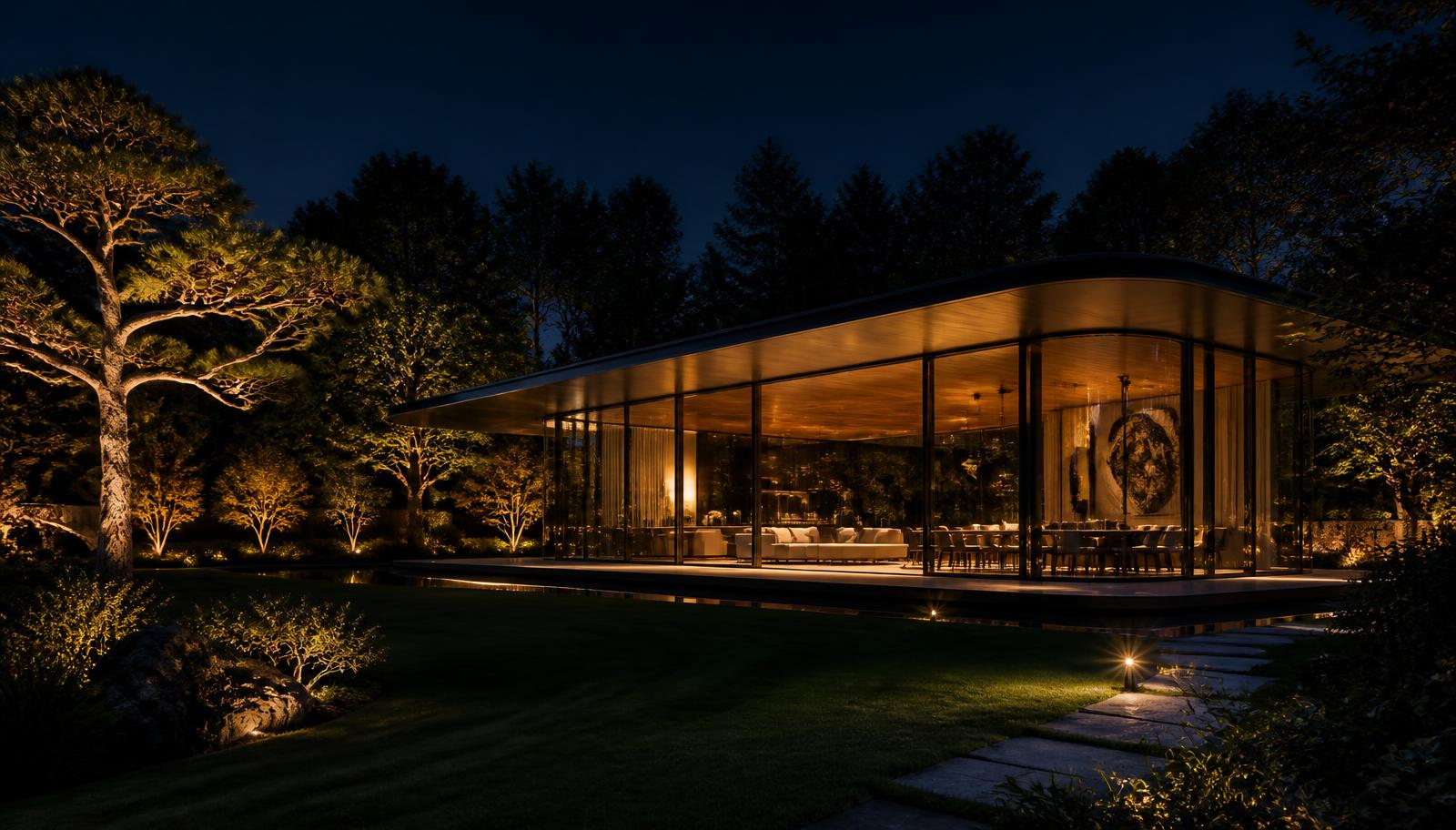
A glass pavilion is the ultimate night-time garden object: the interior light becomes the landscape lighting, the lawn goes black, and a handful of uplit specimen trees define the edges of a garden you can no longer fully see.
Where this is all heading
Future gardens will be climate-responsive, technology-assisted, sculptural and designed for two completely different audiences: the daylight one and the night one. Get the geometry right, plant for your climate rather than your wish list, and spend real money on lighting and water — those are the two things that transform the same garden into a second stage after sunset.
A dedicated parcel drop hatch built into the boundary wall keeps deliveries away from the ornamental entry sequence, which matters on a property where every surface is designed to be photographed.
Gardens rebuilt for a changed climate
Twenty-eight ideas for a garden that works as hard as the house it surrounds
A garden used to be judged by how green it looked in summer. Increasingly it is judged by how little it asks for in return — how little water, how little maintenance, how little waste — while still delivering the shade, privacy and beauty a household wants. Twenty-eight future garden concepts, gathered from projects already being built rather than imagined for a distant future, share this same underlying ambition: a garden that performs as a working system, not just a backdrop.
That system thinking extends beyond planting. The same garden increasingly hosts a home's solar inverter, its battery enclosure, a discreet EV charging bay and, more recently, a small landing area for parcel and food drone delivery. None of this needs to look technical. The best of these twenty-eight concepts hide their infrastructure in plain sight, behind a hedge or beneath a timber deck, so the garden still reads as a garden first.
Planting for a warmer, drier future
The clearest trend across these concepts is a shift away from thirsty lawns and exotic hedging towards climate-adapted planting: native grasses, drought-tolerant groundcovers and species selected for the specific microclimate of a site rather than a generic garden centre palette. A garden planted this way still delivers shade and colour, but it needs a fraction of the irrigation a traditional garden required a generation ago.
Several concepts push this further with edible and productive planting integrated alongside ornamental beds, so a garden produces food as well as shade. Combined with rainwater harvesting from the roof, feeding a tank that supplies irrigation during dry spells, a garden becomes considerably more self-sufficient than the label 'garden' usually implies.
Materials with a lower footprint
Hardscape choices across these concepts favour permeable paving, recycled timber decking and locally sourced stone over quarried imports and solid concrete slabs. Permeable surfaces in particular solve a problem that becomes more pressing every year: heavier, more concentrated rainfall events that overwhelm stormwater systems designed for gentler decades. A garden that lets water soak back into the soil, rather than sheeting off into a drain, is doing real infrastructural work.
Retaining walls and garden edging increasingly use gabion cages filled with site-won rubble, or recycled concrete aggregate cast into new forms, avoiding the embodied carbon of fresh concrete production. These choices rarely change how a garden looks from the street; they change what happened before the garden was built.
How these gardens actually get built
The best-performing gardens in this collection were built in a disciplined order: earthworks and drainage first, then any structural retaining, then the conduit and pipe runs for irrigation, lighting, solar cabling and EV charging, then hardscape, and only then planting. Concepts that were retrofitted after a garden was already established consistently cost more, because trenching through mature beds for a missed cable run damages root systems that took years to establish.
Increasingly, that early services stage includes a spare conduit run to wherever a battery enclosure or car charger might eventually sit, even if neither is installed on day one. It is a cheap insurance policy against a much more expensive dig later, and it is now standard practice among the landscape designers behind these twenty-eight concepts.
Energy, water and the garden as a power system
A number of these concepts treat the garden itself as part of the home's energy system, siting the solar inverter and battery in a purpose-built garden store rather than a garage wall, screened by planting so the equipment disappears from view. Positioned this way, the battery can sit close to a rear driveway or carport, keeping the cable run to an EV charger short and simple.
Solar-powered garden lighting has moved well past the cheap stake lights of a decade ago; low-voltage LED systems now run off the home's main solar and battery circuit, controlled from a phone app that can dim, schedule or colour-shift the garden's lighting for an evening gathering without anyone walking outside to adjust a switch.
Smart control and the arrival of drone delivery
Across these twenty-eight concepts, irrigation, lighting and even garden gates are increasingly managed from a single phone app, letting an owner check soil moisture readings or top up a watering zone during a heatwave without leaving the house. This remote oversight matters more as gardens do more work — a leak or a failed pump can be caught in hours rather than weeks.
The newest concepts also set aside a small, level, paved zone near the garden's edge for drone parcel delivery, wired with a sensor light and kept clear of overhanging branches, alongside a wall-mounted hatch for food delivery drops closer to the kitchen door. It is a small provision within a much larger garden, but it reflects where these twenty-eight ideas are all heading: gardens designed for how households will actually live over the next fifty years, not just how they looked last summer.
Explore more topics
Future Home Design Topics, Concepts and Related Reading
Our other design websites