Glowing pools and water
Glowing Swimming Pools and Luminous Water Features
Pools designed as light sources: fibre-optic floors, glass-walled lap pools, neon coping, illuminated water walls and bioluminescent-look natural lagoons.
Luminous Water
Water designed to glow
Three approaches to making water the light source of the whole outdoor space. Each one places different demands on the pool's construction, finishes and long-term maintenance.
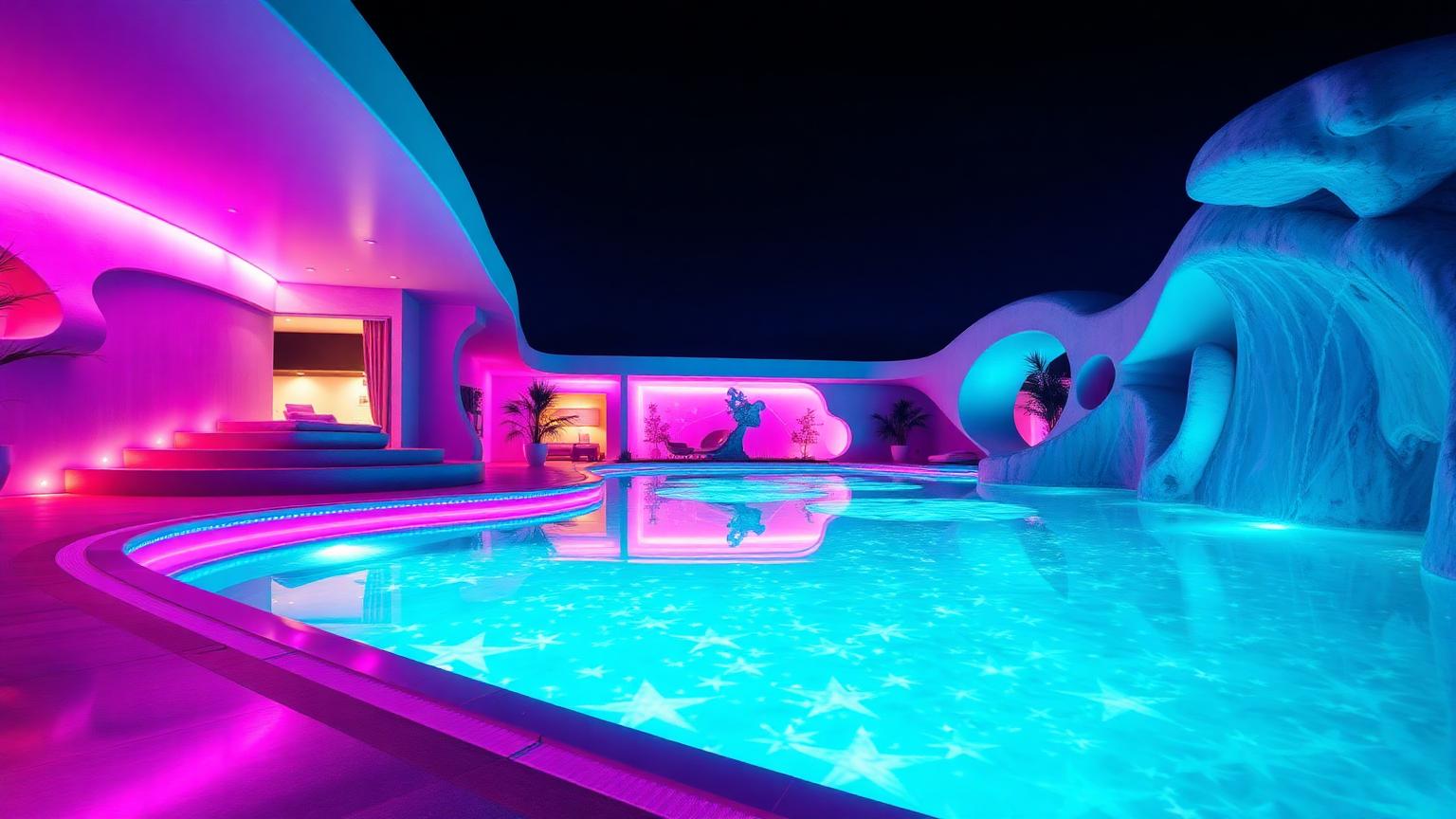
Full-spectrum underwater fittings turn the pool shell into a lantern. A pale interior finish is essential — dark plaster absorbs the light you paid for, while a light quartz or pebble finish throws it back up through the water.
Fibre-optic points set into the floor add depth that flat wall lighting cannot, and because the emitters sit outside the water they are simple to service for the life of the pool.
The illuminator housing the actual light source is typically installed in the plant room, well away from the water, with only the thin, inert fibre cable running to each floor point — a detail that removes almost all of the electrical risk usually associated with underwater lighting.
Choosing the finish is as much a maintenance decision as an aesthetic one: pale quartz and pebble surfaces show algae and staining more readily than dark plaster, so a glowing pool generally needs a slightly more disciplined cleaning and chemical balance regime to keep the light reflecting cleanly.
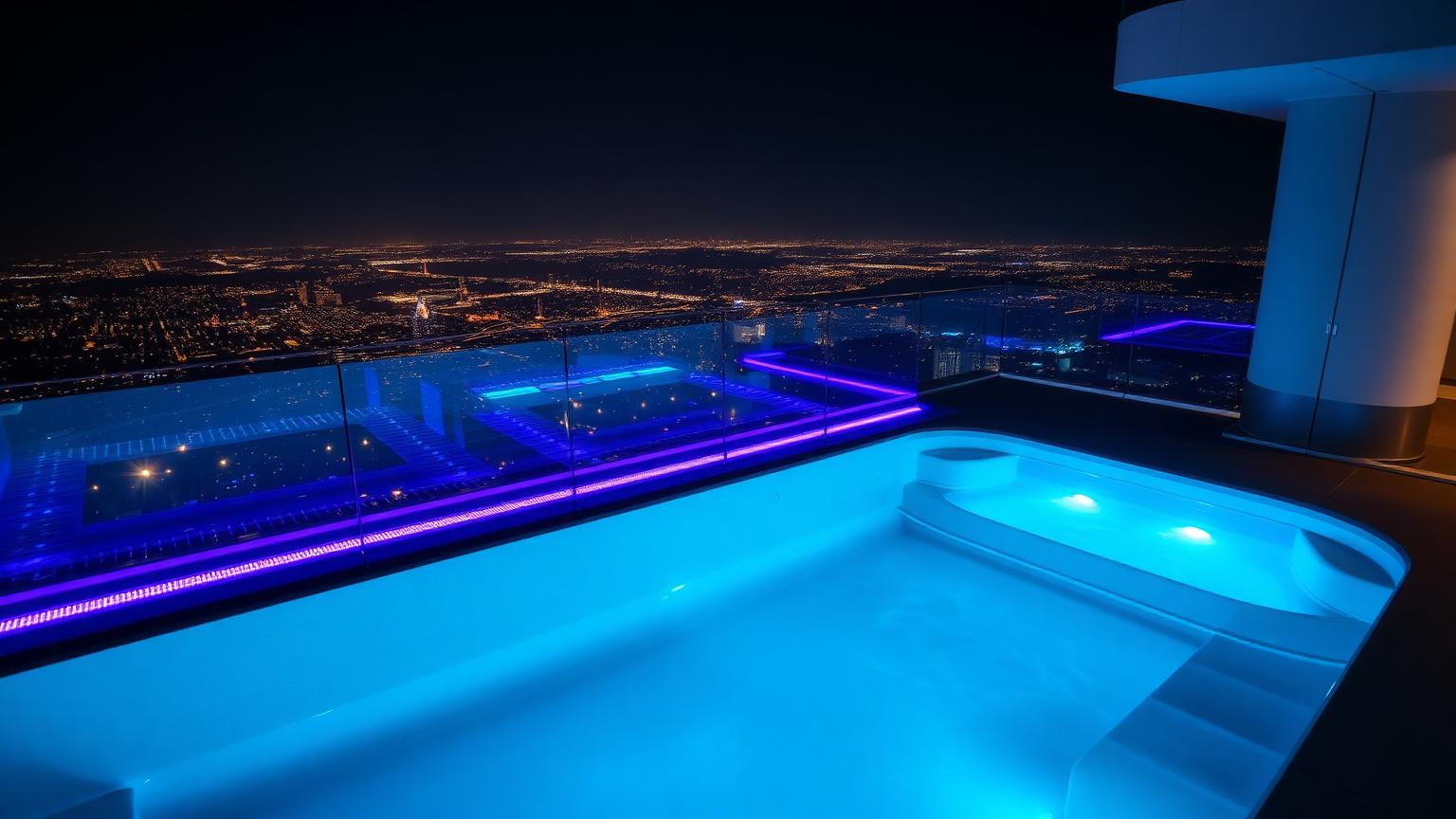
A glass end wall turns a lap pool into a glowing screen visible from inside the house and from the garden below. Structural glass panels are engineered items — they belong in the structural drawings from day one, not in a later variation.
On rooftops, the payoff is the collision between glowing water in the foreground and city light far below. Keep the deck lighting low and cool so nothing competes with it.
Structural glass of this kind is almost always a specialist prefabricated component, manufactured and tested off site to the exact opening size before delivery, because the tolerances involved in a load-bearing, water-retaining glass panel leave no room for on-site adjustment.
Rooftop installations carry an additional load and waterproofing burden that needs resolving at the structural design stage, well before the lighting or glazing package is even selected — retrofitting a rooftop pool onto a structure not designed for the load is rarely economical.
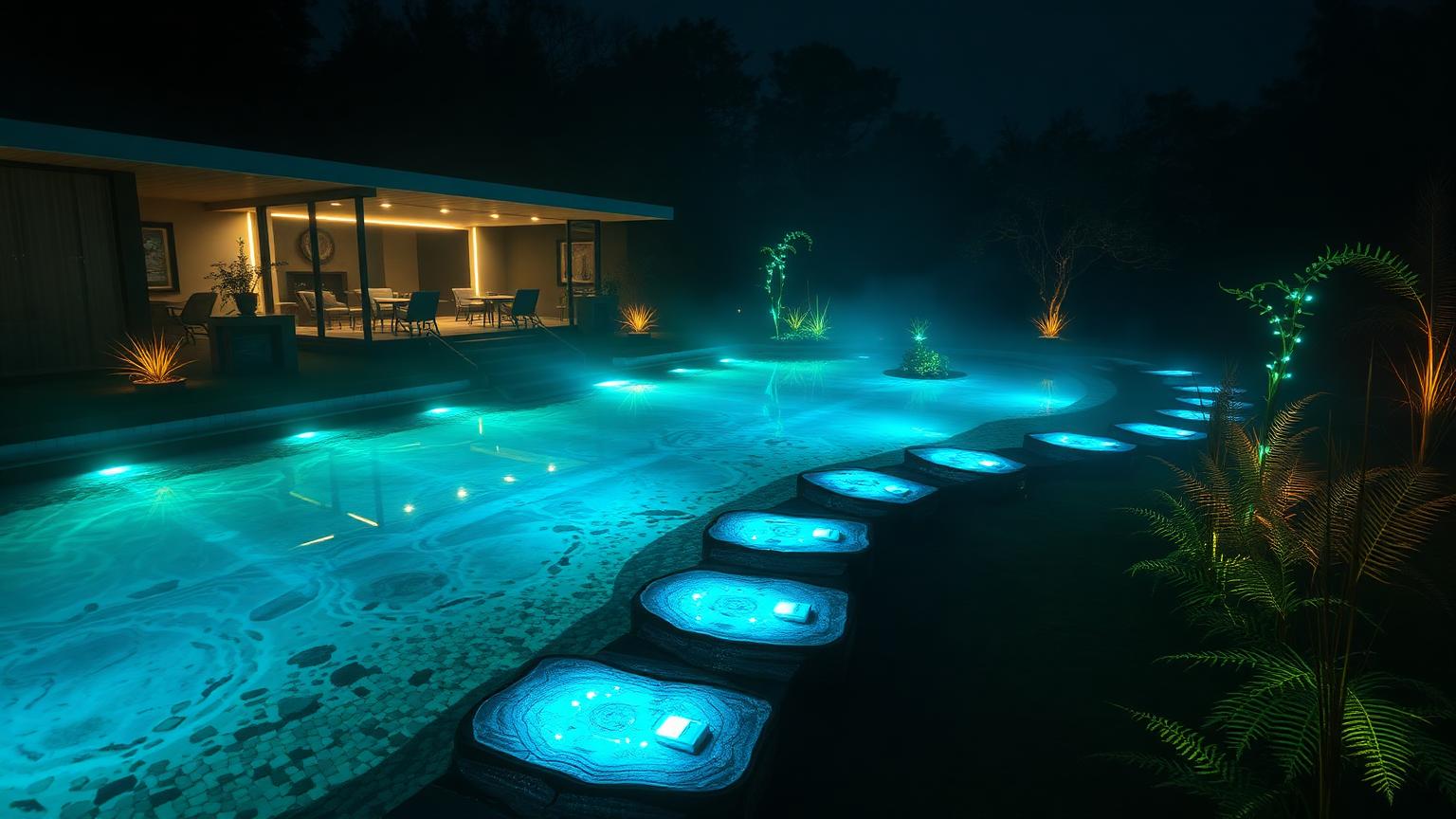
Not every glowing pool needs neon. A natural swimming lagoon with planted filtration zones, lit softly from beneath the waterline in blue-green, reads as something living rather than engineered.
Lit stepping stones and glowing marginal planting extend the effect into the garden, so the water and the landscape blur together after dark.
These systems rely on biological filtration through gravel beds and aquatic planting rather than heavy chemical treatment, which changes the ongoing maintenance profile considerably — less dosing and testing, but more attention paid to planting health and seasonal balance.
Because the lighting sits low and diffuse rather than as a bright point source, low-voltage fittings run from a modest solar-charged battery are usually sufficient, making a natural lagoon one of the more energy-modest ways to achieve a genuinely glowing water feature.
Water as light
The Pool as the Brightest Room in the House
A swimming pool has always been a substantial piece of infrastructure hiding behind a simple idea — a hole full of water. Future pool design treats that infrastructure honestly: the pump, the filtration, the lighting and the structural shell are engineered as one integrated system, and the payoff is a pool that becomes the single brightest, most memorable feature of the property after dark.
This is not an isolated trend. It sits inside a much larger movement toward homes that are considered as whole energy and material systems rather than a collection of separate trades, and the pool is often where that thinking is easiest to see.
The shift toward glowing water
Full-spectrum LED fittings and fibre-optic floors have made colour and depth achievable in a standard residential pool at a cost that would have been unthinkable a decade ago. What has changed is not just the fittings but the finishes around them — pale quartz and pebble interiors that reflect the light rather than absorbing it, and coping details designed from the outset to carry a light line rather than have one added later.
Glass-walled and glass-ended pools push this further, turning the pool into a lit object visible from inside the home as much as from the garden, which changes how the whole ground floor is planned around it.
Materials that hold up to water and light
A glowing pool spends every night with a light source submerged in treated water, so material choice is not cosmetic — it is a durability decision. Marine-grade fittings, UV-stable diffuser lenses and corrosion-resistant fixings are the difference between a pool that still glows evenly in ten years and one that develops dead spots within two summers.
Increasingly, the shell itself is cast off site as a prefabricated composite or fibreglass unit with the lighting conduit built in, craned into an excavated site and connected rather than built up in wet trades over weeks. This shortens the build program significantly and gives a far more reliable finish than hand-applied render.
Energy behind the glow
A pool is one of the more energy-intensive elements of a home when you count the pump running for filtration, heating in cooler months and lighting through every evening. Variable-speed pumps, well-insulated pipework and efficient LED fittings cut that load dramatically, and increasingly the whole system is sized to run from rooftop solar and a home battery rather than drawing from the grid at night.
Solar pool heating, whether through dedicated collectors or an efficient heat pump powered by the home's own panels, extends the swimming season without materially increasing the household's energy bill.
Control, automation and everyday use
App-based control is now standard for anything beyond a basic backyard pool — scheduling filtration for off-peak solar hours, adjusting colour and brightness for an evening gathering, and monitoring chemical balance without a manual test kit. None of this needs to be complicated for the person using it; the complexity sits in the system, not the interface.
A well-designed control system also protects the investment. Automated covers, leak detection and pump diagnostics sent to a phone catch small problems before they become expensive ones, which matters more the more sophisticated the lighting and finishes become.
Looking further out
As gardens increasingly accommodate drone delivery — a landing pad near the pool terrace for a delivered dinner, a parcel hatch tucked into the pool house — the pool area is being planned as part of that logistics layer too, kept clear of low-hanging structures and lit well enough that a landing zone is obvious after dark.
The direction of travel over coming decades is a pool that is essentially self-monitoring: sensors managing water chemistry and clarity, lighting synchronised with the rest of the home's scenes, and energy drawn entirely from what the roof has already collected, so the brightest feature in the garden is also the one that asks the least of its owner.
Explore more topics
Future Home Design Topics, Concepts and Related Reading
Our other design websites