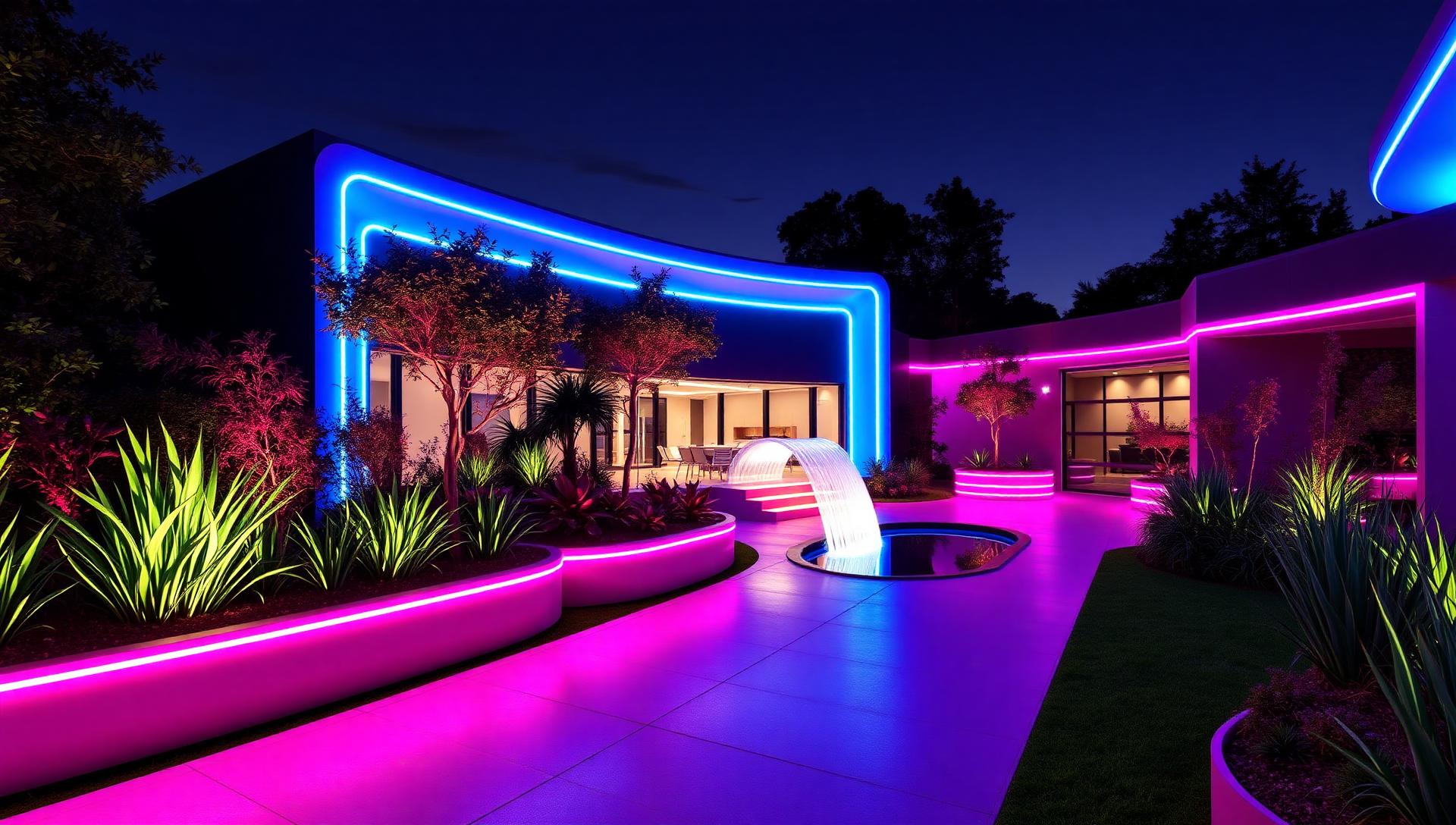
Article No: 5 — Futuristic Gardens
Modern Futuristic Garden Concepts
Lighting, Form and Technology
LED Radiating planters, Glowing pathways, Living green walls, illuminated Pools and parametric canopies — a look at where garden design is heading and how to build it today.
Photo feature
Five futuristic garden concepts
Large format concept photography of neon and LED lighting, vertical planting, Radiating water and sculptural shade.
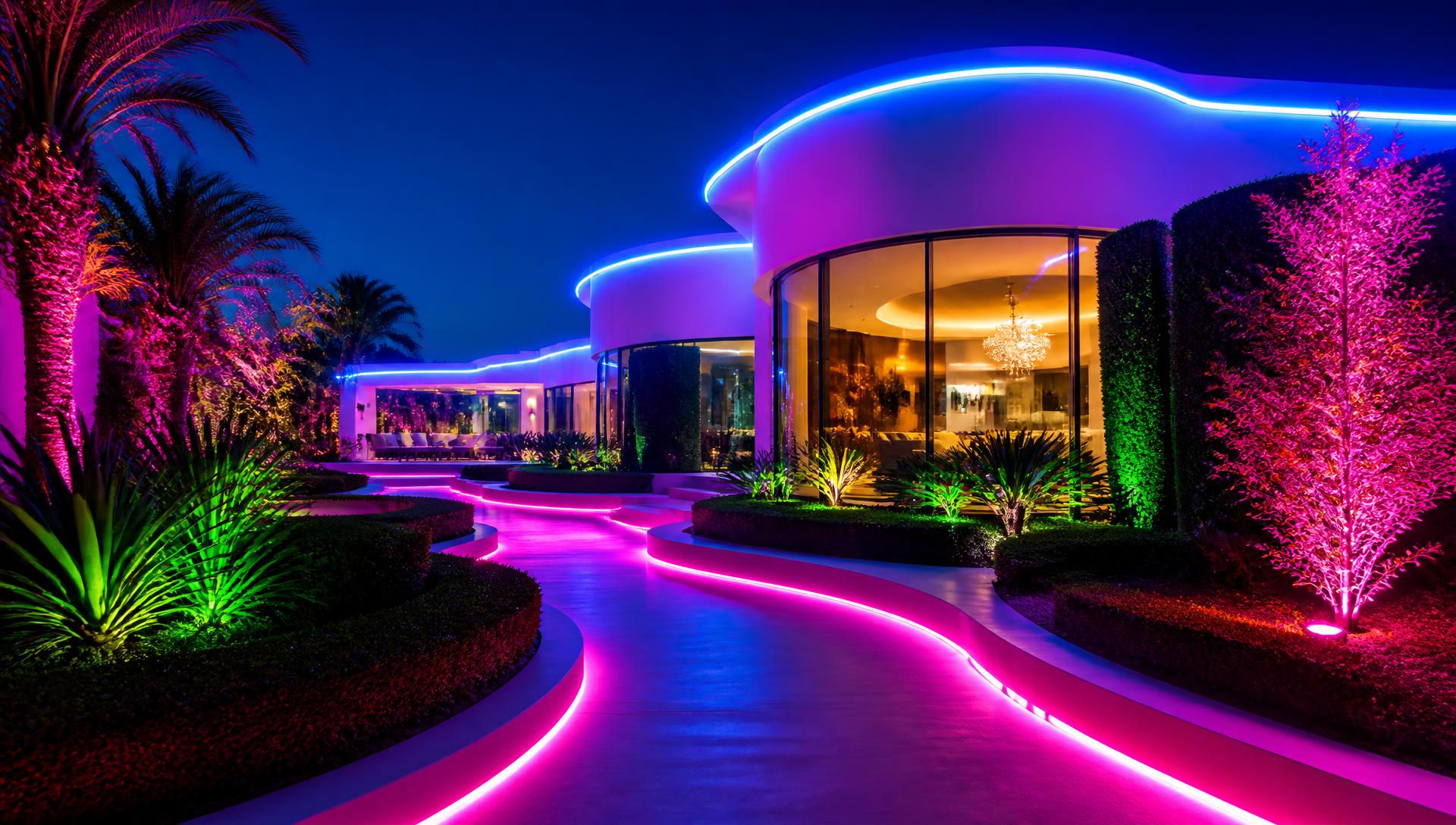
The futuristic garden is designed twice: once for daylight and once for dark. Linear LED lines set into planter edges and path margins turn simple geometry into something that glows after sunset, so the same garden delivers two completely different experiences. Start with clean shapes — the lighting only works if the lines it traces are worth tracing.
The LED channels themselves are typically low-voltage RGBW strips housed in an aluminium extrusion with a frosted diffuser, which spreads the light evenly along the line rather than showing individual diodes as hot spots. Running the whole system from a smart lighting controller lets you save named scenes — a cool white line for entertaining, a slow-shifting colour wash for a quiet evening — and adjust them from a phone anywhere in the house. Black basalt or bluestone paving is chosen deliberately for its low reflectivity, so the LED lines appear to float rather than wash out against a paler surface underfoot.
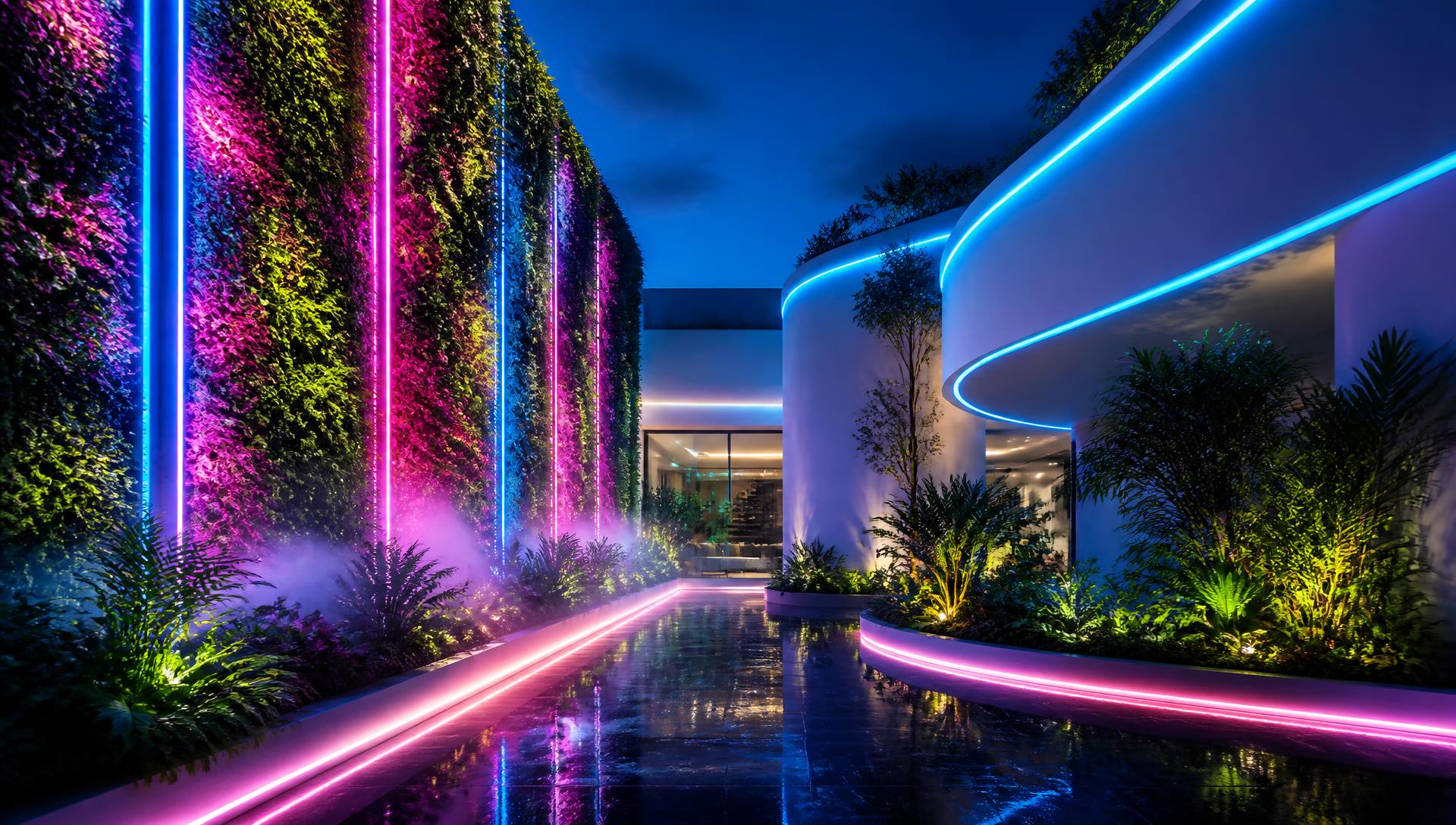
Living walls and vertical planting
Vertical gardens solve the modern problem of small sites: when you have no floor area left, plant the walls. Modular hydroponic systems with integrated grow lighting and automatic irrigation keep a green facade dense even in shaded courtyards, and a fine mist system adds both humidity for the plants and atmosphere for you.
Modular living wall panels are typically felt-pocket or modular plastic tray systems fed by a recirculating drip line, with a header tank and dosing pump adding nutrient solution on a timed cycle rather than relying on soil at all. Full-spectrum LED grow lighting concealed along the top edge of the wall supplements natural light on shaded elevations, run on the same smart scheduling system as the rest of the garden so it switches on automatically as daylight fades. A misting ring plumbed into the irrigation line can be triggered independently for a few seconds at a time, enough to lift humidity around the foliage without ever wetting nearby furniture.
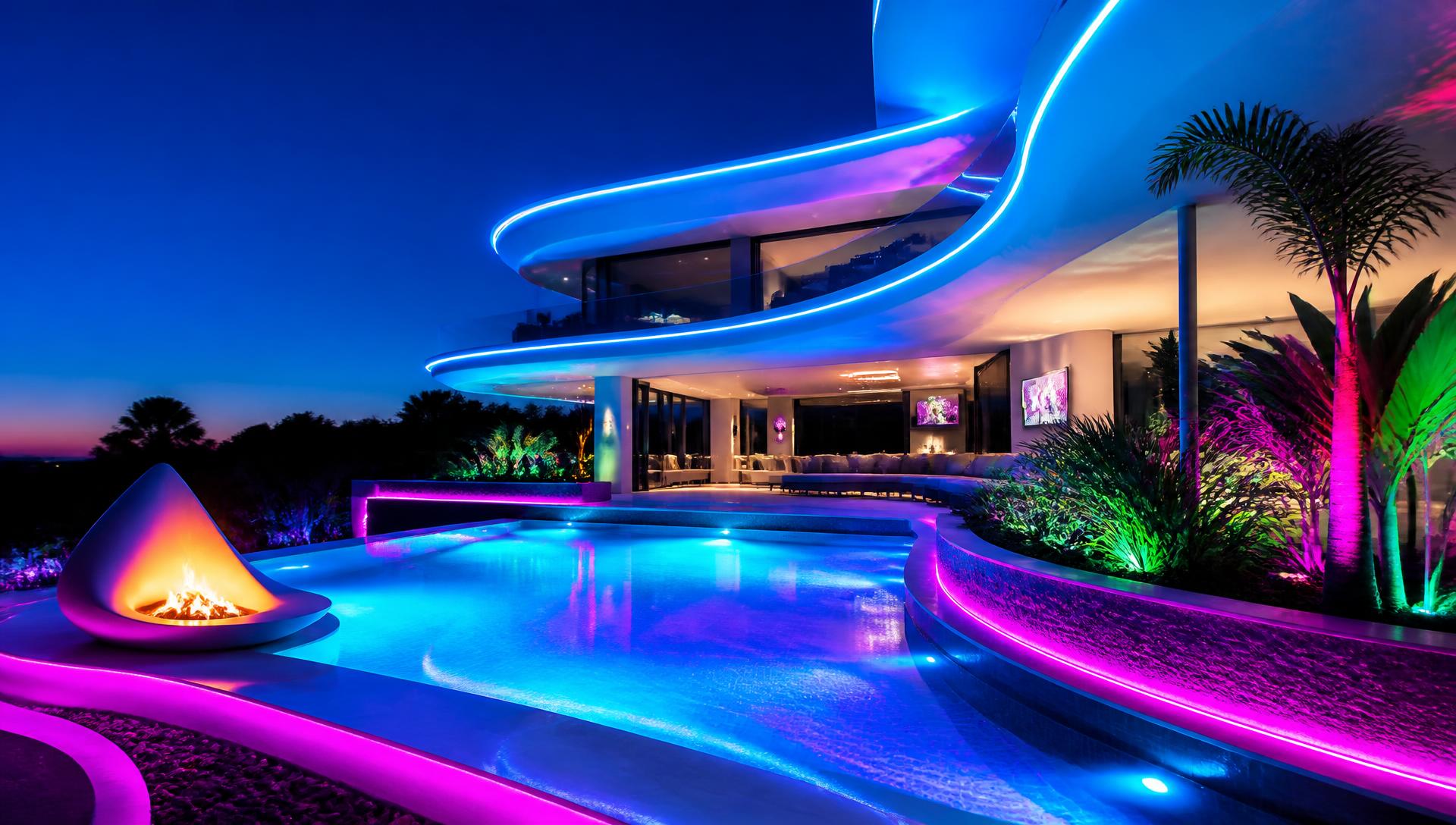
Water, light and fire as one composition
Nothing says futuristic more efficiently than lit water. Colour-changing underwater LEDs, a dark interior finish and a knife-edge overflow make the pool look like a sheet of light, and a single fire element on the axis gives the scene its contrast. Keep the surrounding paving matte and dark so the water is the only bright object.
Underwater colour-changing fittings are best specified in a low-voltage, fully sealed housing rated for continuous submersion, wired back to a central controller so every light in the pool shifts colour in sync rather than drifting out of step with one another. A dark pebblecrete or tiled interior finish is what actually produces the glowing effect, since pale tiles scatter the light rather than reflecting it back as a single deep colour. The knife-edge overflow detail requires a balance tank and variable-speed pump sized precisely to the overflow channel, keeping the sheet of water perfectly even along its whole length, and the fire element is usually gas-fed from a concealed line so it can be switched on instantly by app or remote alongside the pool lighting scene.
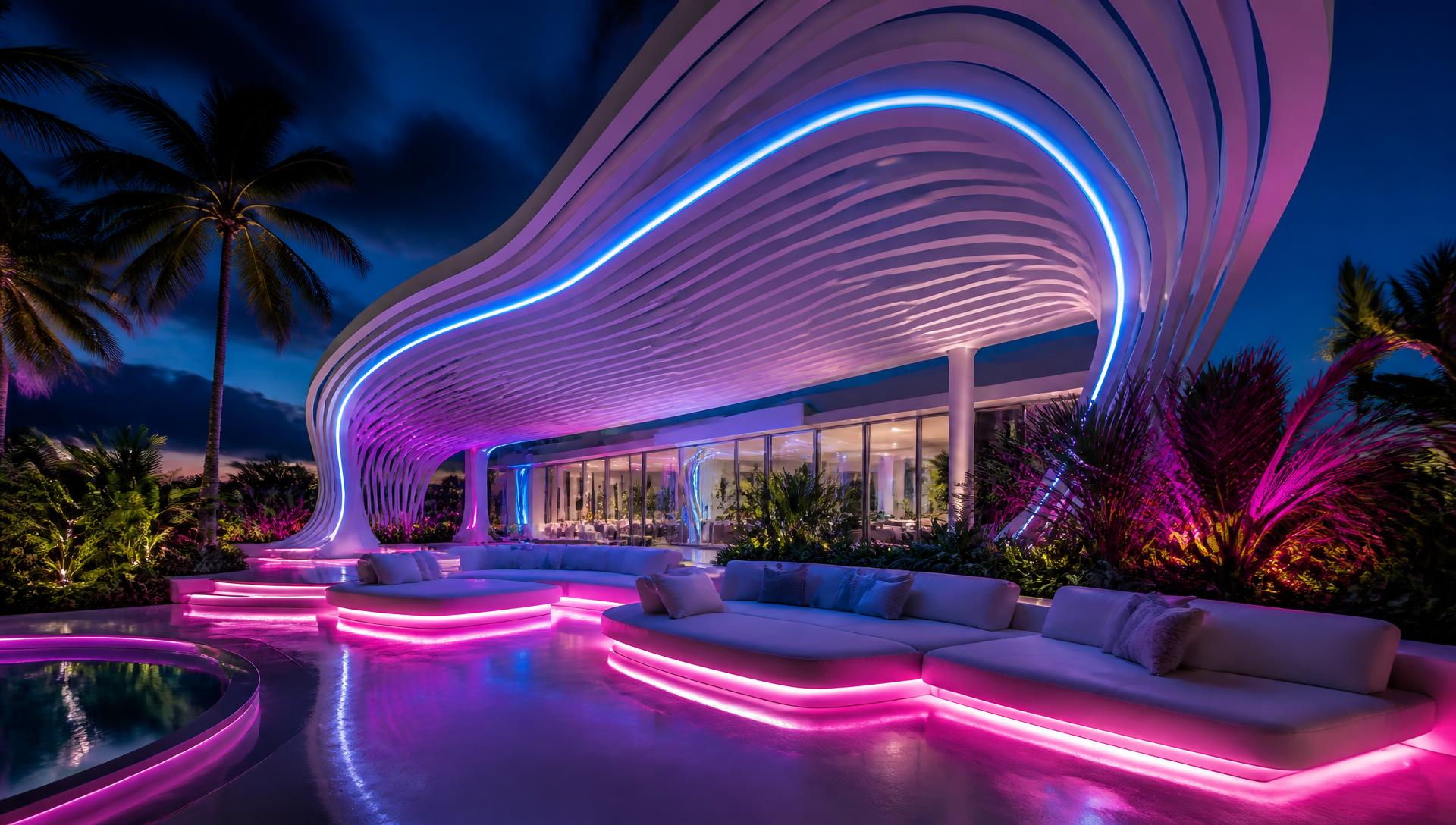
Parametric canopies and sculptural shade
- Curved forms: CNC-cut slats and fabricated steel let shade structures curve instead of sitting square.
- Integrated services: lighting, speakers, heaters and misters concealed inside the structure, never bolted on.
- Louvred roofs: motorised opening louvres give sun, shade or rain cover on demand.
- Furniture to match: low, rounded, monolithic pieces in one pale tone.
Every curved slat in a structure like this is cut from a three-dimensional CAD model, which means the whole canopy is fabricated off site and delivered in sections that bolt together on a concealed steel spine on the day of installation. Running conduit for lighting, speaker cable and heater wiring through that same spine before the slats are fixed avoids any visible cable runs later. Motorised louvre roofs are typically controlled by a rain sensor as well as a phone app, closing automatically the moment a shower starts even if nobody is home, and radiant heaters mounted flush into the underside of the structure extend outdoor evenings well into the cooler months without a single visible bar heater in sight.
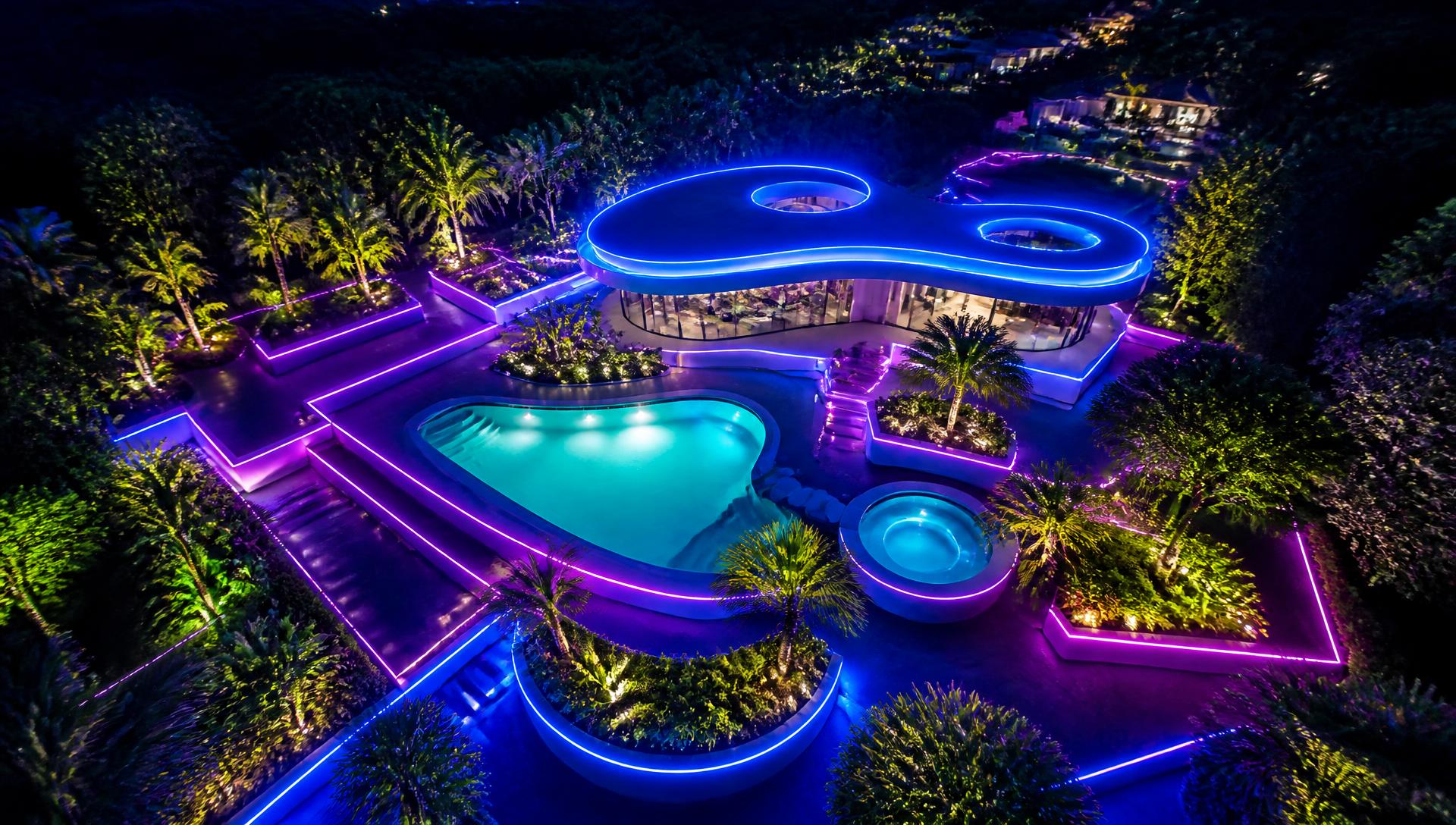
Plan it from above
Futuristic gardens are geometric, which means the plan view matters more than in any other style. Look at your yard from above — satellite view, drone shot or a simple sketch — and resolve the shapes first: the pool rectangle, the terrace grid, the hedge lines. Add the smart irrigation, app-controlled lighting scenes and automation last, once the geometry is right.
A drone photograph taken from directly overhead is genuinely the fastest way to test whether a garden layout works, since it reveals awkward leftover shapes and misaligned lines that are almost invisible from ground level. Soil moisture sensors buried at root depth in each garden zone feed a central irrigation controller that adjusts watering automatically for rainfall and temperature, cutting water use significantly compared with a fixed timer. Once the geometry and irrigation are settled, a single smart home hub tying together pool, lighting, irrigation and gate access means the entire garden can be checked and adjusted from a phone whether you are on the terrace or on the other side of the world.
The next fifty years of outdoor light
Futuristic Gardens Are the Test Bed for Tomorrow's Home Technology
Gardens are usually the last part of a property to get new technology, but futuristic garden design has quietly become the opposite: a proving ground where lighting, materials and automation arrive before they reach the house itself. Glowing planters, illuminated pools and app-controlled irrigation are not novelties bolted onto a finished landscape — they are early, visible versions of systems that will eventually run every part of the home.
Looking ahead, the geometric, LED-lit garden of today is a preview of outdoor spaces that generate their own power, manage their own water, and greet approaching deliveries as readily as they greet people. The next fifty years will not make these gardens less futuristic; it will make the technology inside them invisible, embedded in materials rather than applied as fittings.
Materials built for light and low impact
The dark basalt paving and pale concrete forms that make LED lines pop at night are increasingly sourced as recycled aggregate products, and the planters themselves are moving toward modular, reusable systems rather than poured-in-place beds, so a garden's geometry can be reconfigured without demolition.
Living walls solve two problems in one move: they green a hard-surfaced courtyard without consuming floor area, and their hydroponic systems recirculate water far more efficiently than in-ground irrigation, an efficiency gain that matters more every year as water restrictions tighten.
Solar, battery and the glowing pool
An illuminated infinity pool with colour-changing LEDs and a knife-edge overflow is a genuine load on a property's power bill, which is why the most advanced examples now run their pumps, heaters and lighting from dedicated roof or pergola-mounted solar arrays feeding a battery bank sized specifically for the pool circuit.
The same battery increasingly extends to garden lighting scenes and misting systems, so a property can run its full after-dark spectacle on stored solar energy rather than drawing from the grid at peak evening rates.
Automation, prefabrication and the app
Parametric canopies with motorised louvres, once custom-fabricated one-off structures, are increasingly delivered as engineered kit systems, manufactured off-site and bolted together on a prepared base, cutting installation time from weeks to days without compromising the sculptural curves that define the style.
Every layer — irrigation, pool lighting, louvre position, misting, even EV charging at the driveway edge — now sits behind one mobile app, letting an owner set an entire garden's evening mood, water cycle and charging schedule before they arrive home.
Drone pads and the geometry of tomorrow's plan
Because futuristic gardens are already planned as a geometric grid seen from above, they adapt naturally to a dedicated drone landing pad or a recessed parcel drop hatch worked into the paving pattern, and a marked food delivery zone near the entertaining terrace fits the same disciplined layout without looking bolted on.
As these delivery mechanisms become ordinary, the gardens built today with clean lines and integrated services will simply absorb them, proving that futuristic design was never really about the lighting — it was about planning a space precisely enough that new technology always has somewhere obvious to go.
Where this style is already heading
Landscape designers working on high-specification projects report that clients now request the solar array, the battery, and the app-based control system in the same design meeting as the pool finish and the planting palette, rather than treating power and automation as an afterthought bolted on once the hard landscaping is finished.
That shift is changing how gardens get built as well as how they look: garden structures once poured or built in place are increasingly ordered as prefabricated kits — steel pergola frames, precast planter modules, packaged pool shells — engineered off-site and assembled on a prepared base in days, which shortens a typically slow, weather-dependent stage of any landscaping project.
Fifty years of outdoor technology
Projecting this trajectory forward, the futuristic garden of fifty years from now is unlikely to look more dramatic than today's LED-lit examples; it is more likely to look calmer, with the same glowing lines and lit water but with every visible cable, panel and sensor absorbed into the material itself, since embedding technology into surfaces rather than fixing it on top of them is already the clear direction of travel.
What will not change is the underlying logic that made these gardens futuristic in the first place: a disciplined plan, energy generated and stored on site, and a single point of control, which is exactly the foundation a garden needs to keep absorbing new technology without ever needing to be redesigned from scratch.
Explore more topics
Future Home Design Topics, Concepts and Related Reading
Our other design websites